Two publications on Post-Comparative Philosophy

Ralph Weber, Co-PI of the Reversing the Gaze project, and Lerato Posholi, project member, have contributed to the special feature of Philosophy East and West on โ€œThe Prospects, Problems, and Urgency of Global Intercultural Philosophy Nowโ€.

Ralph Weber departs from the tension between globality and positionality in the context of current attempts to make comparative philosophy more global in scope and more inclusive regarding standpoints. He explores the role of positionality and perspectivism in post-comparative philosophy and inquires into the possibility of meaningful fusion.

Lerato Posholi discusses contemporary debates about methodological issues in philosophy in Africa to raise concerns about the uptake of diverse philosophical resources at the heart of the global post-comparative method. She suggests that the feasibility of the post-comparative method depends on the availability of robust and rich philosophical resources furnished by different traditions and their systematic uptake.

Posholi, Lerato. โ€œOn the Idea of Post-Comparative Philosophy.โ€ Philosophy East and West 75, no. 1 (2025): 43โ€“55.

Weber, Ralph. โ€œGlobal Philosophy, Positionality, and Non-Relativist Perspectivism.โ€ Philosophy East and West 75, no. 1 (2025): 6โ€“22.

Reversing the Gaze international conference, 12-13 Sep 2024 – registration is open

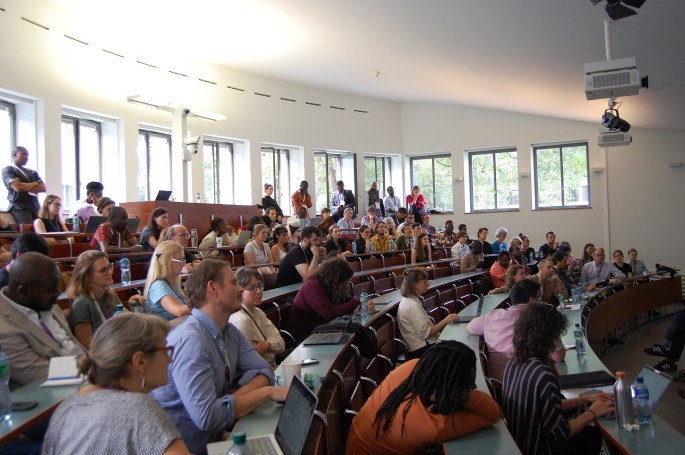
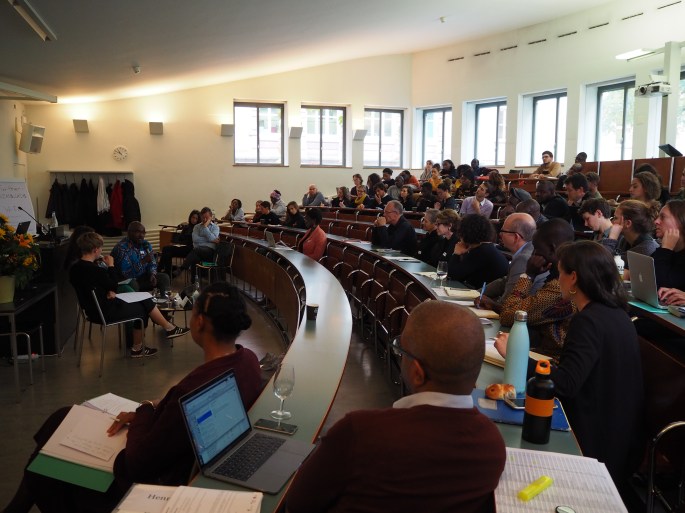
Our two-day conference brings together reflections on the use of concepts across borders in social sciences. In six panel sessions, Swiss and international scholars including “Reversing the Gaze” project members explore the epistemological and methodological implications of applying socio-scientific concepts across regional or historical contexts. The first conference day will conclude with a keynote by Shalini Randeria on “Postcolonial perspectives: quo vadis”; the second conference day with a roundtable discussion.

The conference will take place on 12 and 13 September 2024 at the University of Basel. Registration is free of charge and open until 31 August 2024.

Conference at the University of Basel

Call for papers: “Reversing the Gaze: Using Concepts Across Borders”

The use of concepts deemed โ€˜Eurocentricโ€™ in analyzing the global South is heavily criticized within the context of postcolonial and decolonial debates. Such critiques are concerned with the entanglement of the concepts and their colonial context โ€“ whether a moral concern with the possibility that colonial worldviews are ineradicably present in the forms and substance of these concepts; an empirical concern with the complicity of these concepts in colonial projects of rule, violence, and extraction; or a concern that colonial structures (e.g. racial hierarchies; geographies of center and periphery) are replicated in conceptual structures in ways that limit their validity or utility. Furthermore, critics lament the traditional geography of theory, whereby the West gazes towards the Rest, and in doing so imagines the universality of the former and particularity of the latter.

In doing so, these critiques raise doubts about the assumption that concepts can be analytically fruitful beyond their context of origin and the normative assumptions on which they are based. The project โ€œReversing the Gaze: Towards Post-Comparative Area Studiesโ€ takes as its core issue whether concepts are inextricably tied to their context and the circumstances of their origins. It does so by deploying concepts used to describe identifiable social and institutional phenomena, typically used to account for phenomena in non-European settings, to study similar empirical phenomena in Europe. Case studies apply the concepts โ€œre-tribalizationโ€, โ€œpolitical societyโ€ and โ€œthe cunning stateโ€ to study, respectively, citizenship in Switzerland, populism in Austria and social welfare spending in Italy.

This conference brings together reflections on the use of concepts across borders in social sciences. The conference has two aims. The first aim is to share and discuss the results of our three case studies, and to examine other cases of applying socio-scientific concepts across regional or historical contexts. The second aim is to explore the epistemological and methodological implications of turning the gaze traditionally directed at the Rest towards the West. The discussions of the case studies will present key substantive findings from the studies, providing some concrete material for reflecting on epistemological and philosophical questions about concepts, and hopefully these questions will inform interpretations of the results of the case studies.

Furthermore, we wish to bring this work into conversation with other research that explores theoretical and/or empirical questions related to:

  1. The functions and performativity of social-scientific concepts of specific social and institutional phenomena, i.e. whether they produce descriptions, or whether the deployment of concepts itself produces the objects which concepts describe.
  2. Conceptual change in such concepts, i.e. whether (and how) concept use, scope and meaning change fundamentally according to where, why and by whom they are deployed.
  3. Theoretical and political aspects of the use of such concepts across borders, i.e. whether the use of some concepts can be inappropriate for the study of particular contexts due to some properties of the concepts and/or studied contexts.

To this end, we welcome contributions addressing these questions and related others from any discipline and research field.


Submitting a proposal

Paper proposals should include a title and a description (in English, maximum 2000 characters) as well as name, e-mail address and institutional affiliation/function of the author(s).

Proposals must be submitted via the Evasys submission form.


Timeline & practical information
  • Call for papers: 15.12.2023
  • Deadline for paper submissions: 15.03.2024
  • Notice of acceptance: 15.04.2024
  • Conference: 12-13.09.2024

Detailed program, venue and fees to be announced


Best Paper Prize (runner up) for Deval Desai

The Society of Legal Scholars (SLS) awarded RtG project member Deval Desai the Best Paper Prize (runner up) for his paper โ€˜Theorising the anti-fiscal state: evidence from Indiaโ€™ at their Annual Conference 2023. The SLS is the principal representative body for legal academics in the UK whose aim is the advancement of legal education and scholarship in the UK and Ireland.

Desaiโ€™s paper ties in with the project research on government underspending undertaken by his work package.

Read more on the website of the Edinburgh Law School.

Other recent publications by Desai include โ€˜Law and the political stakes of global crises: Lessons from development practice for a coronavirus worldโ€™, published by Law and Policy and available as Open Access. This article explores the relationship between law and crisis, in particularly the lessons the Global North can learn from experiences in the Global South, where such thinking is framed in terms of โ€˜developmentโ€™.

University of Basel ‘In Focus’ Portrait: Lerato Posholi

Project member Lerato Posholi spoke to the University of Basel about her postdoc and the broader Reversing the Gaze project.

Photo: University of Basel/Eleni Kougionis

As part of the University of Basel’s summer “In Focus” series, Lerato Posholi spoke about her postdoctoral research on the politics and philosophy of concepts and their use, as part of the work package on Concept Travel, Comparison, and Area Studies. “European experiences and perspectives are often applied to Africa or South America, and Europe’s experiences are portrayed as universal. For this reason, the social sciences are frequently accused of being Eurocentric,” she explains.

Read more on the website of the University of Basel.

Lerato Posholi and Ralph Weber participate in workshop at the University of Johannesburg

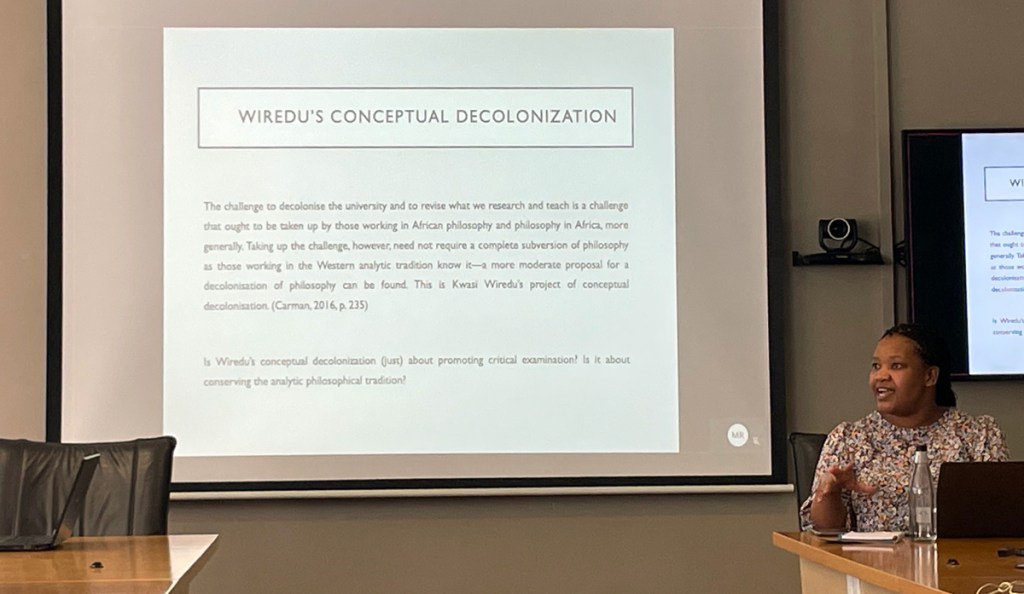
โ€œEpistemic Injustice and Epistemic Decolonisationโ€ was the topic of a workshop organised by the African Centre for Epistemology and Philosophy of Science of the University of Johannesburg. The event took place on 9 March 2023 in the context of a collaboration visit by project members Lerato Posholi and Ralph Weber from 6โ€“10 March 2023. 

Lerato Posholi presented a talk titled ‘Wiredu’s Conceptual Decolonisation: A Radical Reading?’ Photo: Veli Mitova

In the course of the workshop, the participants explored different aspects of decolonisation and epistemic injustice, including concepts and politics of Eurocentrism (Ralph Weber), the question of how to decolonise (Dimpho Takane), Kwasi Wireduโ€™s conceptual decolonisation (Lerato Posholi), or the complications of decolonising the curriculum (Veli Mitova).

The workshop was organised by the University of Johannesburgโ€™s African Centre for Epistemology of Science in collaboration with the Reversing the Gaze project.

Read more on the website of the Institute for European Global Studies, Basel.

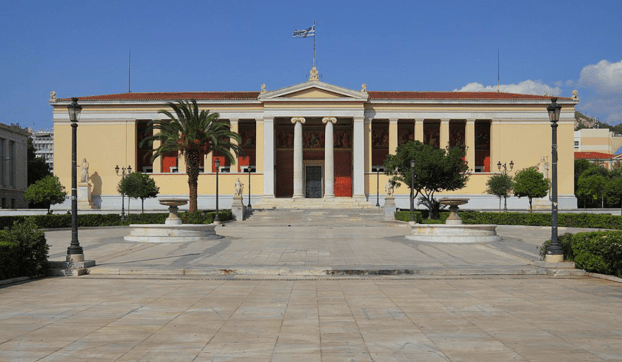
Decolonial Promise or Pitfall? Ralph Weber on “Reversing the Gaze” at Workshop in Athens

Ralph Weber, co-Principal Investigator of the Reversing the Gaze project, presented some of the key ideas regarding the project at the Comparative Political Theory Workshop 2022 at the National and Kapodistrian University of Athens on April 13 and 14, 2022.

For Professor Weber, “Reversing the gaze” means working towards a more truly global history of political thought and comparative political theory. He recently presented this process . In his talk, he analyzed in how far it constitutes a decolonial promiseโ€” or a pitfall.

The Comparative Political Theory Workshop 2022 was held under theme “Authoritarianism in the Eurasian Context: From Antiquity to the Present”. The aim of the workshop was to bring together scholars to discuss the emerging acceptance of authoritarianism in the contemporary world and to reflect upon and derive insights from the rich historical experience and the depth of sources produced by Eurasian cultures from antiquity to the present.

Ralph Weber is Associate Professor of European Global Studies at the Institute for European Global Studies. He specializes in Political Theory, Chinese Politics, and modern Confucianism. Currently, he is the President of the European Association for Chinese Philosophy and the Chair of the Section on Political Theory in the Swiss Political Science Association.

4 QUESTIONS TO… Lerato Posholi

I hope for an engagement with โ€˜Southernโ€™ critiques of global knowledge production that moves beyond a reductive understanding of the critiques as merely political.”

Lerato Posholi is a postdoctoral researcher at the University of Basel. She is part of the working package โ€Concept Travel, Comparison, and Area Studiesโ€ of the โ€Reversing the Gazeโ€ project.


Can you explain your research area in three sentences?

Partย of my research looks at the politics of global knowledge production through engagement with Southern critiques of knowledge e.g. decolonial thought. I take seriously the idea that knowledge is socially constructed, and I explore the political-ethical implications of this idea asย ย brought up by notions of epistemic injustice and epistemic oppression.ย Iย alsoย have a growing interest in the philosophical field of conceptual engineering.


What key questions would you like to answer in your case study?

Ourย sub-project considers two very broad questions. The first question is how concepts and concept travel is understood and critiqued especially in โ€˜Southernโ€™ critiques ofย knowledge and eurocentrism. The second question we reconsiderย is how we can conceptualise comparison and reframe comparative studies in light of the method of โ€˜reversing the gazeโ€™.ย 


What is your envisioned outcome of the overall project?

I hope for an engagement with โ€˜Southernโ€™ critiques of global knowledge production that moves beyond a reductive understanding of the critiques as merely political. I hope that the project helps us better frame what is epistemologically at stake in the issues we take up and engage with.ย 


What are you most looking forward to in this collaboration?

I look forward to working with the diverse disciplinary experts on the team and seeing what insights come up when we look at the โ€˜Northโ€™ using concepts from the โ€˜Southโ€™. I also look forward to forming new networks and collaborations through the project.


4 QUESTIONS TO… Matthias Maurer Rueda

I hope that our research project can help shift the way we think about politics in Switzerland.”

Matthias Maurer Rueda is a doctoral candidate at the University of Basel. He is a researcher in the case study on “Citizenship, Migration and Re-Tribalisation” of the “Reversing the Gaze” project.


Can you explain your research area in three sentences?

Mostly, I am interested in the role that emotions โ€“ particularly feelings of belonging โ€“ play in Swiss politics, especially among conservative voters. We all need to make sense of our affective understanding of the world, and to do so we rely heavily on myths and stories: they provide powerful narratives to make sense of our feelings, and they help to unite the myriad of very personal, individual interpretations of the world under solidified, clearly delineated group identities. On a more meta-level, I look at the relationship between academic and everyday language, and how concepts change as they travel between the two.


What key questions would you like to answer in your case study?

Many people in Switzerland seem to be getting angrier and angrier, and no one really knows why –  and much less what to do about it. I think we struggle to understand recent developments โ€“ the renewed surge of populism, the increasing polarization โ€“ because we misunderstand the way people do politics on a more fundamental level. In my research, I hope to show that by accounting for the emotional, personal side of politics, some of the puzzles we face in the social sciences turn out to be less perplexing after all.


What is your envisioned outcome of the overall project?

On a more practical level, I hope that our research project can help shift the way we think about politics in Switzerland, and the appeal of populist narratives more broadly. Alternative narratives are needed, but if they do not connect on an emotional level, if they see voters as policy-preference-calculators rather than people, they will inevitably fall short of conviction. I also hope to convey, through my personal research and the work of the entire project, that science can and should be a lot more creative than is commonly understood. Decolonial calls to de-center โ€˜Westernโ€™ research practices shouldnโ€™t only be made on an ethical or political level. Exploring new forms of knowledge-making is a scientific necessity, and we should engage and embrace these developments as opportunities to think about the world in new and enlightening ways.


What are you most looking forward to in this collaboration?

I really enjoy the transdisciplinarity of the project. There is a wide range of interests, experiences and approaches amongst the team, and I do not think I have left a conversation without something new to think about. It makes for a very stimulating environment, and I canโ€™t wait to put all the ideas that have been stewing in my head out there.


4 QUESTIONS TO… Peter Geschiere

“THE IDEA OF ‘REVERSING THE GAZE’ CAN BE VERY HELPFUL, IF IT IS RELATED DIRECTLY TO GLOBAL AND LOCAL POWER RELATIONS, ALSO FOR HIGHLIGHTING THE AMBIGUITIES AROUND DECOLONIZATION.”


Peter Geschiere is Emeritus Professor of Social Anthropology (University of Amsterdam). He is a fellow in the โ€œReversing the Gazeโ€œ project.


Can you explain your research area in three sentences?

I am an anthropologist, but also a historian. I undertake field-work in various parts of Cameroon and elsewhere in West Africa. Central topics in my work include local ways of dealing with state formation, decolonization, โ€™โ€™witchcraftโ€™โ€™ and lately my focus lies on homophobia and freemasonry. 


How did you become involved in this project as a fellow ?

I got to know Elรญsio Macamo from collaborating with him at the International African Institute (SOAS University of London), but also through his lectures and publications. I very much like his subtle approach to complex issues such as decolonization and reversing the gaze. It was therefore a pleasure to join this project and to get an insight into the various case studies.

Elรญsio asked me to participate in this project as my book on issues of citizenship, belonging and exclusion (Perils of Belonging: Autochthony, Citizenship and Exclusion in Africa and Europe, 2009) was based on this idea of reversing the gaze โ€“ looking at the Dutch suddenly using notions like autochthony, or allochthony from the longer history of these concepts in Cameroon and elsewhere in Francophone Africa. Generally speaking, I was intrigued by the concept of ‘reversing the gaze’, especially how it relates to power-relations. 


What are you most looking forward to in this collaboration? 

I look forward to seeing how this idea of โ€˜โ€™reversing the gazeโ€™โ€™ will be related to empirical research, and also how this will connect to debates on decolonization. The idea of โ€˜reversing the gazeโ€™ can be very helpful, if it is related  directly to global and local power relations, also for highlighting the ambiguities around decolonization. At first, decolonization seems to be a self-evident notion, but it is important to go deeper into the ambiguities and complications that emerge as soon as we try to make it concrete in specific contexts.


What is your envisioned outcome of this project?

Anthropology should be about giving others a voice, which is why it is critical that diverse perspectives and positions in global networks are reflected. This is undoubtedly the case within this project. A danger for especially anthropologists is that โ€œreversing the gazeโ€œ inspires an obsession with self-reflexivity which can end up ‘muting’ the voice of the Other. โ€œReversing the gazeโ€œ must be most explicitly in making other voices to be heard.