Publication: “Recasting Welfare Politics in India at the Time of COVID-19”

Project member Christine Lutringer‘s recent book chapter explores state-society relations and subnational responses to the COVID-19 crisis in India. By examining the intersection of governance and welfare, Lutringer reveals the shifts and tensions in state-society relations that have been induced by the pandemic. The chapter argues that not only the policy response of the central government in Delhi but also the narratives and discourses of the pandemic intrinsically relate to the ways in which “welfare” has been constructed in India.

“Recasting Welfare Politics in India at the Time of COVID-19” by Christine Lutringer (2023) is published in Milanetti, Giorgio, Miranda, Marina and Morbiducci, Marina (eds.) The COVID-19 Pandemic in Asia and Africa. Societal Implications, Narratives on Media, Political Issues. Volume II โ€“ Society and Institutions. The book is published by Sapienza Universitร  Editrice and is available as Open Access.

Best Paper Prize (runner up) for Deval Desai

The Society of Legal Scholars (SLS) awarded RtG project member Deval Desai the Best Paper Prize (runner up) for his paper โ€˜Theorising the anti-fiscal state: evidence from Indiaโ€™ at their Annual Conference 2023. The SLS is the principal representative body for legal academics in the UK whose aim is the advancement of legal education and scholarship in the UK and Ireland.

Desaiโ€™s paper ties in with the project research on government underspending undertaken by his work package.

Read more on the website of the Edinburgh Law School.

Other recent publications by Desai include โ€˜Law and the political stakes of global crises: Lessons from development practice for a coronavirus worldโ€™, published by Law and Policy and available as Open Access. This article explores the relationship between law and crisis, in particularly the lessons the Global North can learn from experiences in the Global South, where such thinking is framed in terms of โ€˜developmentโ€™.

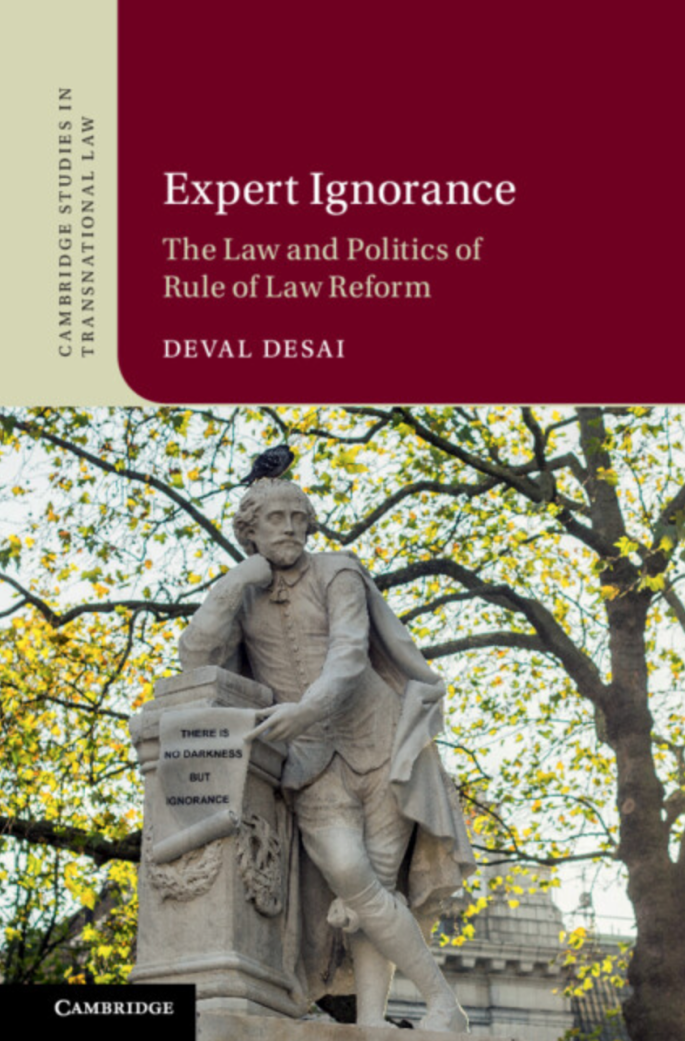
Publication: “Expert Ignorance”

This recent book by project member Deval Desai explores the concept of โ€˜expert ignoranceโ€™, whereby ideas about the โ€˜rule of lawโ€™ remain undefined and are indeed kept underdetermined by structures of expertise. This, in turn, regulates their ability to travel beyond their context, for example, in their application in the Global South. Desaiโ€™s interdisciplinary approach spans legal theory, development practice, global economic governance and sociology to demonstrate โ€œthe enduring power of proclaiming what one does not know.โ€

Expert Ignorance is published by Cambridge University Press as part of the Cambridge Studies in Transnational Law series, and is available as Open Access on Cambridge Core.

Workshop: “Decoloniality and the Politics of the Urban” (hybrid, 27 Oct 2022)

The Geneva Graduate Institute, the Reversing the Gaze Project and the Institute for Advanced Studies in the Humanities (IASH) invite you to participate in an upcoming workshop, exploring themes of decoloniality in relation to the politics of the urban.

Date: 27th October 2022
Time: 9:00-16:30 UK time
Format: Hybrid

What is the politics of the divide between the urban and the non-urban (semi-urban, peri-urban and the rural), in contemporary postcolonial and metropolitan contexts, as well as historical colonial contexts? The divide is fundamental to the emergence of modern states as political-economic entities – European, colonial, and developmental. It expresses a politics of concentration/scale, productivity, specialisation, and movement to be governed. Crucially, colonial histories and categories of urban and rural and their relationship to productive and unproductive labour give shape to internal hierarchies of citizenship within states. The politics of these categories manifest themselves in historic rubrics of retribalisation, and contemporary politics of internal labour migration and populist resentment. The divide is of interest as at once a material site, political framework, and historical stage for the making of colonial and postcolonial states โ€“ and potentially for the continuation of an โ€œunfinished project of decolonisationโ€.

This is a unique opportunity to engage with interdisciplinary scholarship on relevant themes of decoloniality, both historical and contemporary. If youโ€™re interested in participating in a panel, kindly submit a short abstract (no more than 200 words) to tanushree.kaushal@graduateinstitute.ch and deval.desai@ed.ac.uk with the title โ€˜Decoloniality Workshop Submissionโ€™ and your name and affiliation by October 3th, 2022. If you have any questions, feel free to contact Tanushree at tanushree.kaushal@graduateinstitute.ch.

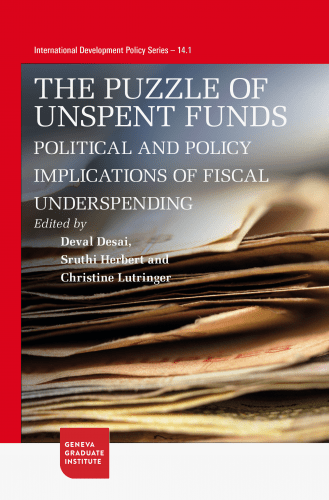
Publication: “The Puzzle of Unspent Funds”

This special issue edited by our project members Deval Desai, Sruthi Herbert and Christine Lutringer explores a matter of critical policy relevance and political importance: the unuse or underuse of public funds, and more specifically of special purpose social funds. The contributions ask: why are there unspent social purpose funds, what do they tell us about the structures of the administrative state, and what can be done to remedy the situation?

The eight chapters, which include contributions by project members Tanushree Kaushal, Luciano Monti and Anna Rita Ceddia, span across two different contexts : India and Italy. These radically different contexts also present valuable points of comparison. The analyzed funds diverge in terms of their institutional design, type of benefits and eligibility of beneficiaries. At the same time, they sit within decentralized democratic frameworks and fragmented and multilevel governance. Juxtaposing the cases, the papers reveal key processes related to fiscal, administrative and policy practices that cause underspending. The papers provide an innovative vantage point to analyze institutional design and reforms in multilevel governance contexts; administrative and bureaucratic state practices; modalities of state-society engagement; and mechanisms to increase democratic accountability.

Desai, D., S. Herbert and C. Lutringer (eds) (2022) The Puzzle of Unspent Funds. Political and Policy Implications of Fiscal Underspending, International Development Policy / Revue internationale de politique de dรฉveloppement, 14.1 (Geneva: Graduate Institute Publications). DOI: 10.4000/poldev.5048

Content
  • Deval Desai, Sruthi Herbert and Christine Lutringer: Introduction. Critical Issues Emerging from the Study of Unspent Funds
  • G. K. Karanth: Managing Unspent Funds when Money is Scarce: Karnataka State Construction and Other Workers Welfare Board (kcowwb)
  • Lipin Ram: Funds Spent: The Lessons and Challenges of Keralaโ€™s Exceptional Experience
  • Tanushree Kaushal: The Aestheticisation of Governance in India: The Appeal of Urban Aesthetics in Microfinance
  • Himanshu Upadhyaya: Registration, Expenditure and Audit Trends: A Technical Commentary on the Karnataka Building and Other Construction Workersโ€™ Welfare Board
  • Christine Lutringer: The Puzzle of โ€˜Unspentโ€™ Funds in Italyโ€™s European Social Fund
  • Luciano Monti: The Italian Puzzle of the European Youth Guarantee
  • Anna Rita Ceddia: The Pivotal Role of Mid-level Implementation Bodies in Italyโ€™s Cohesion Policy  

Call for Papers: “Post-Pandemic Mobilisation and Management of Social Welfare Funds”

Project members Sruthi Herbert and Deval Desai host a workshop on “Post-Pandemic Mobilisation and Management of Social Welfare Funds: Implications for Equity and Citizenship” at the annual conference of the Development Studies Association (6-8 July 2022). They discuss the fiscal and administrative practices that emerged in public welfare spending after the COVID-19 pandemic through the lens of equity and citizenship.

The workshop explores a matter of critical policy relevance and political importance: the fiscal and administrative practices that emerged post-pandemic to rapidly mobilise funds for the pandemic relief, and its implications for equity and citizenship. The case-study of special-purpose vehicles (SPVs) in India guides this discussion.

Sruthi Herbert and Deval Desai (Edinburgh) will be the co-convenors. They welcome abstracts for papers from scholars, writers and activists engaged in monitoring and analysing the management and use of public/earmarked funds in India or other regions of the world.

The deadline for submissions is 4 March 2022. The conference is taking place online on 6-8 July, organised and hosted by University College London.

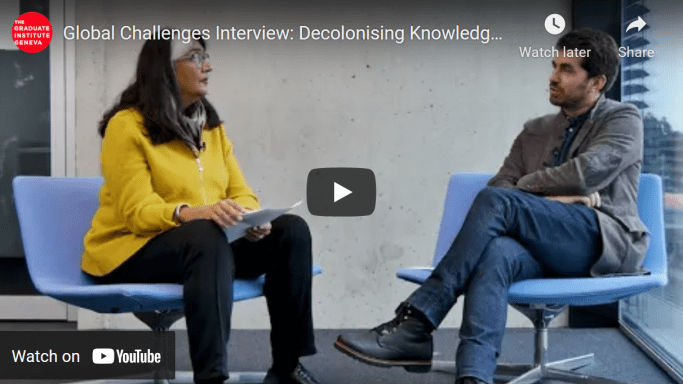
“Decolonising Knowledge”: Interview with Shalini Randeria

The October 2021 edition of Global Challenges from the Graduate Institute of Geneva (IHEID) features Reversing the Gaze fellow, Shalini Randeria, in conversation with IHEID Director of Research and Professor of Anthropology and Sociology, Grรฉgoire Mallard. The video interview “Decolonising Knowledge: A Historical Perspective from Socio-Anthropology” appears in the introduction of the recently published research webzine.

Global Challenges is a series of dossiers aimed to communicate the ideas, expertise, perspectives, and discussions generated by the Graduate Institute of International and Development Studies with a larger, non-specialist audience.


Shalini Randeria

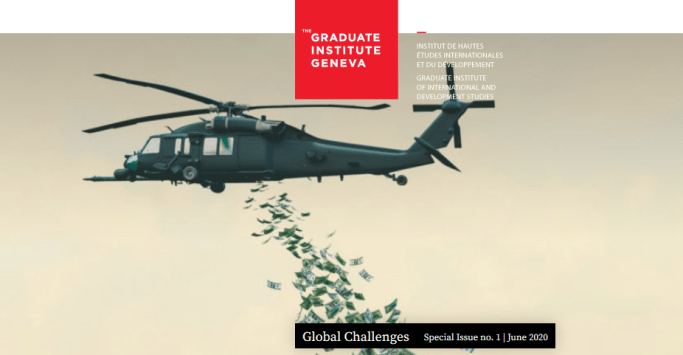
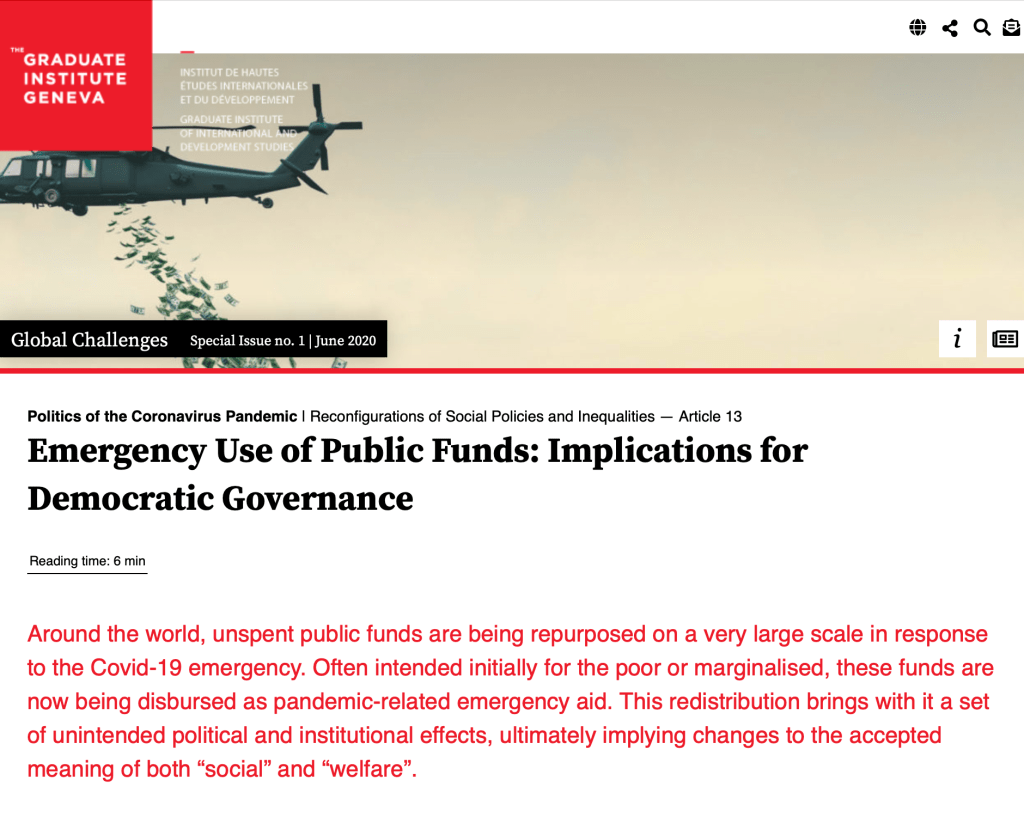
Publication: ”Emergency Use of Public Funds: Implications for Democratic Governance”


In this paper, three of our project team: Shalini Randeria (Fellow), Deval Desai (Principal Investigator) and Christine Lutringer (Researcher) demonstrate a set of unintended political and institutional effects of the emergency mobilisation of unspent social welfare funds under Covid-19.

This article was originally written for Global Challenges:

> Desai, D., Lutringer, C., & Randeria, S. (2020) Emergency Use of Public Funds: Implications for Democratic Governance, Global Challenges, special issue no. 1, June.


Christine Lutringer

Shalini Randeria

Deval Desai