University of Basel ‘In Focus’ Portrait: Lerato Posholi

Project member Lerato Posholi spoke to the University of Basel about her postdoc and the broader Reversing the Gaze project.

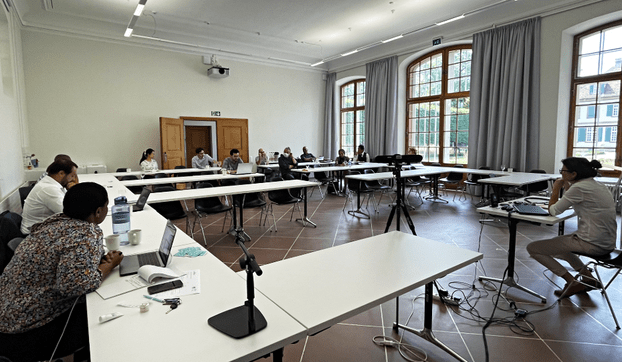
Photo: University of Basel/Eleni Kougionis

As part of the University of Basel’s summer “In Focus” series, Lerato Posholi spoke about her postdoctoral research on the politics and philosophy of concepts and their use, as part of the work package on Concept Travel, Comparison, and Area Studies. “European experiences and perspectives are often applied to Africa or South America, and Europe’s experiences are portrayed as universal. For this reason, the social sciences are frequently accused of being Eurocentric,” she explains.

Read more on the website of the University of Basel.
“Concepts without borders”: Reversing the Gaze at the VAD Conference

Watch the roundtable and panels convened by our project members at the conference of the Association for African Studies in Germany (VAD) in Freiburg im Breisgau (7-10 June 2022).

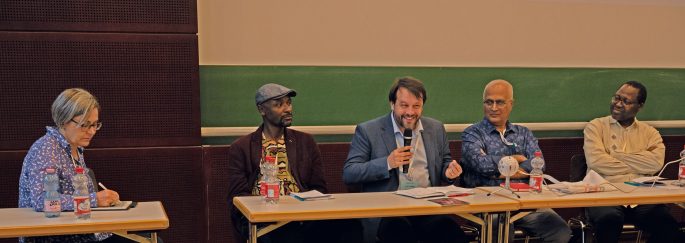
Rose Marie Beck, Patricio Langa, Ralph Weber, Peter Ronald DeSouza and Elรญsio Macamo at the roundtable “Concepts Without Borders”, VAD Conference in Freiburg i.Br., 8 June 2022

Concepts without borderS – reciprocating analytical perspectives

Roundtable chaired by Elisio Macamo (University of Basel) and Ralph Weber (University of Basel)

Speakers: Patrรญcio Langa (UWCUEM), Peter DeSouza (Retired Professor), Rose Marie Beck (University of Leipzig), Claudia Derichs (HU Berlin)


The politics and epistemic value of positionality

Panel convened by Lerato Posholi and Ralph Weber


Translating concepts from Africa to Europe

Panel convened by Winnie Kanyimba and Matthias Maurer Rueda


Workshop: “The Philosophy and Global Politics of Concept Travel”

Veli Mitova (African Centre for Epistemology and Philosophy of Science, University of Johannesburg) during her presentation titled “Wilful Ignorance and Concept Travel”.

On June 17, the workshop on “The Philosophy and Global Politics of Concept Travel” brought together philosophers and social scientists from India, South Africa and Switzerland to reflect on the link between concept travel, conceptual engineering and the politics of knowledge production. The discussions raised various issues about the dominance of Eurocentric concepts in social science; possible advantages and disadvantages of concept travel; and outlined some strategies for conceptually engineering concepts.

The workshop was part of Lerato Posholi and Ralph Weber’s work package in the “Reversing the gaze” project and was organized in collaboration with Prof. Veli Mitova from the African Centre for Epistemology and Philosophy of Science, University of Johannesburg.

4 QUESTIONS TO… Lerato Posholi

I hope for an engagement with โ€˜Southernโ€™ critiques of global knowledge production that moves beyond a reductive understanding of the critiques as merely political.”

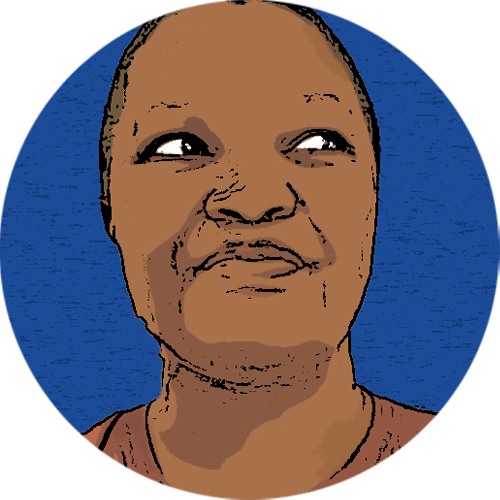
Lerato Posholi is a postdoctoral researcher at the University of Basel. She is part of the working package โ€Concept Travel, Comparison, and Area Studiesโ€ of the โ€Reversing the Gazeโ€ project.


Can you explain your research area in three sentences?

Partย of my research looks at the politics of global knowledge production through engagement with Southern critiques of knowledge e.g. decolonial thought. I take seriously the idea that knowledge is socially constructed, and I explore the political-ethical implications of this idea asย ย brought up by notions of epistemic injustice and epistemic oppression.ย Iย alsoย have a growing interest in the philosophical field of conceptual engineering.


What key questions would you like to answer in your case study?

Ourย sub-project considers two very broad questions. The first question is how concepts and concept travel is understood and critiqued especially in โ€˜Southernโ€™ critiques ofย knowledge and eurocentrism. The second question we reconsiderย is how we can conceptualise comparison and reframe comparative studies in light of the method of โ€˜reversing the gazeโ€™.ย 


What is your envisioned outcome of the overall project?

I hope for an engagement with โ€˜Southernโ€™ critiques of global knowledge production that moves beyond a reductive understanding of the critiques as merely political. I hope that the project helps us better frame what is epistemologically at stake in the issues we take up and engage with.ย 


What are you most looking forward to in this collaboration?

I look forward to working with the diverse disciplinary experts on the team and seeing what insights come up when we look at the โ€˜Northโ€™ using concepts from the โ€˜Southโ€™. I also look forward to forming new networks and collaborations through the project.


Book Chapter: ”Comparative philosophy and comparison” by Ralph Weber

Comparative philosophy is lively and the field is diverse and assembles different, sometimes even contradictory views. In his contribution to the edited volume ”Comparative Methods in Law, Humanities and Social Sciences”, Ralph Weber presents these different views and then proceeds to deal with the current conceptualisation of the logic of comparison, with specific attention for diminishing bias and the adequacy of bases of comparison. He helpfully states that one way of investigating the inner dynamics of a given comparison is to ask a set of questions: Who is performing the comparison? What commonality supports the choice of what has to be compared? What is being compared with what? In what respect(s) does the comparer compare that which they compare? What relation results from comparing what the comparer compares in that particular respect? How does the choice of the pre-comparative tertium restrict the realm of possible tertia comparationis? How does a chosen tertium comparationis qualify the comparanda? And what role does the comparanda play in the result of the comparison? Each of these questions reveals an enormous complexity, and the answers may be subject to criticism or require further clarification and substantiation. Moreover, most if not all of these questions are highly relevant for comparative legal research too. Weber also deals with some specific issues, such as generalisation, one-sidedness, and the identification of similarities and differences.

Workshop Report: Keywords for India, and Beyond?

In thisย report, Lerato Posholi (researcher in the Reversing the Gaze project) discusses the workshop ”Keywords for India, and beyond? Enriching the Global Social Science Vocabulary” with Rukmini Bhaya Nair (Indian Institute of Technology, Delhi) and Peter deSouza (Goa University). The event was organized by Ralph Weber (Principle Investigator of the project) and Lerato Posholi as an inception workshop in the framework of the Reversing the Gaze project.


Keywords for India, and Beyond? Enriching the Global Social Science Vocabulary

On the 7th of May 2021, Prof. Ralph Weber and Dr Lerato Posholi organized a workshop with Prof. Rukmini Bhaya Nair (Indian Institute of Technology, Delhi) and Prof. Peter deSouza (Goa University). The workshop used Bhaya Nair and deSouzaโ€™s book ยซKeywords for India: A conceptual lexicon for the 21st centuryยป as a point of departure for reflecting on the core question of whether, and how, certain keywords for and from India (e.g. guru or nirvana or policy paralysis) can apply or be used to study contexts beyond India. The discussion covered some of the central themes of the Sinergia project ยซReversing the gaze: towards post-comparative area studiesยป on the politics of conceptual travel, theoretical challenges to using concepts beyond their context of origin, and broader concerns around the nature of comparison.

Two broad sets of critical insights were foregrounded in the contributions and discussions between invited speakers and participants. The first set of insights raised questions regarding the notion of โ€นreversing the gazeโ€บ: what does it mean? Which gaze are we reversing? Why must we โ€นreverse the gazeโ€บ? How do we โ€นreverse the gazeโ€บ? Prof. Bhaya Nair highlighted that the notion of โ€นreversing the gazeโ€บ commonly amounts to a call to study Europe just as Europe studies the rest of the world but proposed that โ€นreversing the gazeโ€บ should go beyond this to inspire ways of seeing the world anew. She remarked that in their book, the placing of โ€นbig academic conceptsโ€บ such as democracy and subaltern next to everyday Indian keywords such as balti (Hindi/Urdu for โ€นbucketโ€บ) can provide new perspectives on the world. Prof. deSouza added a critical perspective on the notion of โ€นreversing the gazeโ€บ by raising the question: ยซwho is doing the gazing?ยป This question is loaded with topical issues about positionality and how it affects knowledge production.

The second set of insights surrounded the topic of concept travel. On this topic, the concern was whether all concepts can travel and what the conditions of possibility for concept travel are. Two key points were raised on this issue. The one point was that concepts can be deeply embedded in certain theoretical frameworks and socio-cultural contexts, making it difficult for them to be applicable outside their contexts of origin. The speakers emphasized that some of the keywords for India may be so embedded in Indian contexts that they are not applicable elsewhere, or may first need to be made fit for travelling, as had been the case with karma. The second point raised a word of caution against taking for granted that travelling concepts retain their original meaning in different contexts. Concepts, especially social concepts, tend to expand or change meaning precisely in their travelling. For example: the concept of human rights, some may say, has expanded and evolved precisely because the original conception of human rights has been challenged in applications of the concept in many different contexts.

Overall, the fruitful discussions from the workshops raised important questions that will help us do some ground clearing in the Sinergia project. These questions and insights call for careful clarification of what is meant by โ€นreversing the gazeโ€บ in the project and an illustration of how this reversal of the gaze can produce post-comparative area studies.


This report was originally written for the monthly newsletter of the Institute for European Global Studies (University of Basel):

> Newsletter: Nr. 132 Juli 2021 | Europainstitut | Institute for European Global Studies


Peter deSouza
Ralph Weber
Lerato Posholi

Towards Post-Comparative Philosophy: Interview with Ralph Weber

In a recent interview Ralph Weber, Principle Investigator in the Reversing the Gaze project, discussed his vision of a post-comparative philosophy with Nevad Kahteran (University of Sarajevo). The discipline, he says, should allow philosophers to be informed by a global outlook and use a variety of styles and conceptualizations from different traditions.

Weber seeks to address the issues of Eurocentrism and methodological problems in comparative philosophy. His book “Comparative Philosophy without Borders” (co-edited with Arindam Chakrabarti) analyzes previous approaches to comparative philosophy and offers paths towards post-comparative avenues.


> Article: ”Towards Post-Comparative Philosophy: Interview with Ralph Weber”, Asian Studies, 9(2),pp. 211-221 (open access)

> Book: ”Comparative Philosophy without Borders”, edited Arindam Chakrabarti and Ralph Weber (2015, Bloomsbury Academic)

Ralph Weber

Interview with Elรญsio Macamo and Ralph Weber on the project “Reversing the Gaze”

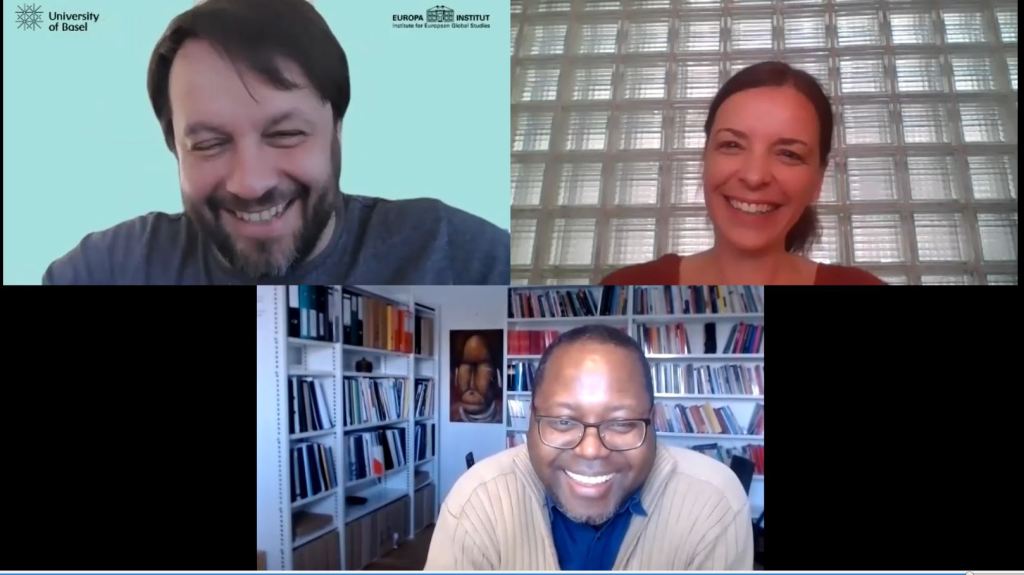
Prof. Ralph Weber (top left), Prof. Elรญsio Macamo (bottom row) and Anita Soltermann (top right) during the interview.

The Grants Office of the University of Basel interviewed two of our principal investigators, Elรญsio Macamo and Ralph Weber, about the project ”Reversing the Gaze”, interdisciplinarity, trends in research funding, and the Covid-19 crisis.


Read the interview on the Grants Office’s website

Elรญsio Macamo

Ralph Weber