In the media: ”Fehlt uns eine gemeinsame Welt?”

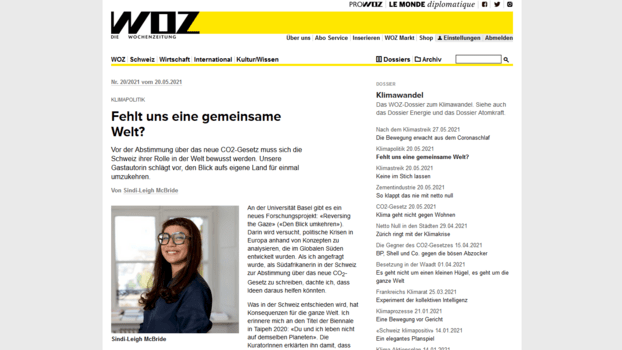
In the run-up to the national vote on the Co2 law in Switzerland, a guest article in the Swiss weekly WoZ calls for the country to become aware of its role in the world and refers to the research project “Reversing the Gaze”. The author, Sindi-Leigh McBride is a PhD candidate at the Centre for African Studies of the University of Basel, with a guest article in WoZ (20 May 2021)

The article is written in German.

>“Fehlt uns eine gemeinsame Welt?” on woz.ch (paywall)

Interview with Elรญsio Macamo and Ralph Weber on the project “Reversing the Gaze”

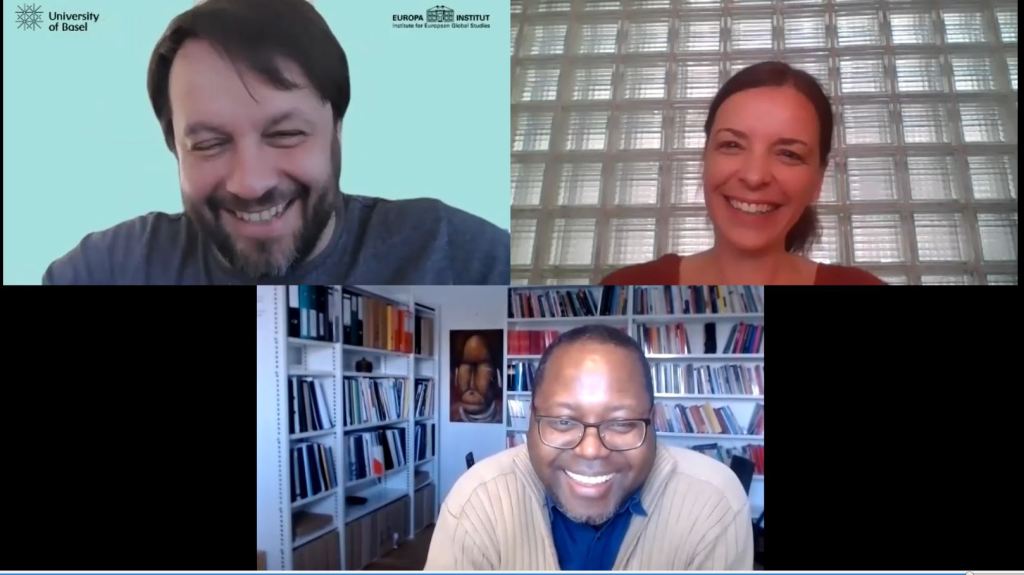
Prof. Ralph Weber (top left), Prof. Elรญsio Macamo (bottom row) and Anita Soltermann (top right) during the interview.

The Grants Office of the University of Basel interviewed two of our principal investigators, Elรญsio Macamo and Ralph Weber, about the project ”Reversing the Gaze”, interdisciplinarity, trends in research funding, and the Covid-19 crisis.


Read the interview on the Grants Office’s website

Elรญsio Macamo

Ralph Weber

4 QUESTIONS TO… Elรญsio Macamo

”I am committed to the old-fashioned view that there is only one science.”

Elรญsio Macamo is a Professor of Sociology and African Studies at the University of Basel. He is one of the Principal Investigators in the โ€œReversing the Gazeโ€œ project, and leads the case study on โ€œStrangers in our midstโ€.


Can you explain your research area in three sentences?

Firstly, and most importantly, I am concerned with the knowledge that we produce about Africa, i.e. I am interested in the methodologies used to bring it about and worried about the quality of that knowledge. Secondly, I am interested in how we, as academics, can make knowledge about Africa relevant to the various disciplines. Thirdly, I am committed to the idea of science, and, for this reason, I attempt to contribute to it by working on how best to produce knowledge.


What key questions would you like to answer in your case study?

What I am aiming to show is that there are no boundaries to knowledge. I am interested in using questions raised in connection with Africa to shed light on Switzerland’s fundamental issues. If we manage to do that, we will essentially reveal that science’s boundaries do not lie where we tend to think they do.


What is your envisioned outcome of the overall project?

This project’s overall goal is to engage in broader discussions about topics such as post-colonialism, decoloniality and epistemological hegemony. These have been going on for 30 or 40 years. They are important debates. They take issue with the central place that certain regions occupy in knowledge production and the assumption that this is highly problematic. There is the suggestion that there is a non-European science, and I’m not happy with that. I am committed to the old-fashioned view that there is only one science, and if we can meet our stated research goals, we would make a significant contribution to this broader debate. We will demonstrate that there is only one science, and that is what we should focus on.


What are you most looking forward to in this collaboration?

I am thrilled about the whole project and its originality. I am also very excited about the two doctoral students, Tebuho Winnie Kanyimba and Matthias Maurer Rueda. I am looking forward to seeing how they will overcome the challenge of doing African Studies research in Switzerland.

Overall, it is stimulating to work with the whole project team. It is brilliant. I highly respect the work of my colleagues and love what they have done so far. I can learn so much from them, and it is exciting to have the opportunity to work so closely with them. Lastly, I’m excited about the resonance of our project, if we do our work well, there will be responses, and if we do our work exceptionally well, these responses will be extreme. We might have to brace up some rough times as the debates we engage with address controversial topics. 


Student assistant (6 hours per week), research

The Chair of African Studies at the Department of Social Sciences at the University of Basel is looking for a student assistant (6 hours/week) as part of the research project Reversing the Gaze: Towards Post-Comparative Area Studies funded by the Swiss National Science Foundation.

Tasks

The successful candidate will assist a research team consisting of two doctoral students and a professor organizing events, transcribing data, managing data, searching literature, copy-editing/proofreading and content management (website).

Profile

Candidates must be registered students at the University of Basel, ideally in the final stages of their BA or beginning of their MA studies. We are looking for a reliable and motivated student with an interest in the broader politics of migration and a commitment to research. Good English language skills (oral and written) are required, good language skills in German and/or French are desirable.

Position

We offer a position in an interdisciplinary project and in a vibrant and open work environment.This student assistant position with six hours per week is scheduled to start on 1 October 2020 and is limited to one year. The general University regulations for student assistants apply.

Application/Contact 

Applications should include the following documents:

  1. Motivation letter (maximum two pages);
  2. Curriculum vitae (maximum two pages);
  3. Certificates, references, diploma;
  4. A writing sample in English.

Deadline for submission: 31 August 2020

Student assistant (6 hours per week), coordination

The Centre for African Studies Basel and the Department of Social Sciences at the University of Basel look for a student assistant (6 hours/week) as part of the research project Reversing the Gaze: Towards Post-Comparative Area Studies funded by the Swiss National Science Foundation.

Tasks

The successful candidate will assist the project coordinator in administration, research management and communication. The tasks include travel management, organizing events, data management, copy-editing/proofreading and content management (website).In addition, the successful candidate will support the team of the executive office of the Centre for African Studies in its daily business.

Profile

Candidates must be registered students at the University of Basel, ideally in the final stages of their BA or beginning of their MA studies.We are looking for a reliable and motivated person with quick comprehension and good working knowledge of common office software. Very good English language skills (oral and written) are required, good language skills in German and/or French are desirable.

Position

We offer a position in an interdisciplinary project and in a vibrant and open work environment.This student assistant position with six hours per week is scheduled to start on 1 October 2020 and is limited to one year. The general University regulations for student assistants apply.

Application/Contact

Applications should include the following documents:

  1. Motivation letter (maximum two pages);
  2. Curriculum vitae (maximum two pages);
  3. Certificates, references, diploma
  4. A writing sample in English

Deadline for submission: 31 August 2020
Two PhD positions in the subproject “Citizenship, Migration and Retribalisation in Switzerland”

The Chair of African Studies in the Department of Social Sciences at the University of Basel is looking for two PhD candidates to work within a SINERGIA Collaborative Research Project on “Reversing the Gaze: Towards Post-Comparative Area Studies” funded by the Swiss National Science Foundation. The Chair is in charge of a work package with the title “When There are Strangers in our Midst โ€“ Citizenship, Migration and Retribalisation in Switzerland”.

Project description

The work package foresees two qualitative studies to be carried out in Switzerland on two distinct civil society groups in the field of migration and citizenship. Drawing upon the concept of “retribalisation” developed in the context of anthropological research in Africa during the colonial period, the study will inquire into two distinct groups in Switzerland in order to test the relevance of using concepts developed in Africa to an understanding of phenomena in Europe. One group campaigns for an independent Switzerland, i.e. for a country that stresses a national identity unconstrained by transnational institutions such as the European Union and the United Nations, whereas the other group claims allegiance to liberal democratic values and emphasises a liberal definition of Swiss identity. In relation to immigration, both groups position themselves in contrasting ways and appear well-suited to test the relevance of the concept of “retribalisation”.

The study will focus on the life-worlds of these activists as they are shaped by the dynamic socio-cultural change brought about by immigration. The issues to be pursued are:

  • (a) The social profile of activists
  • (b) Their places of contact and social intercourse
  • (c) Their definitions of themselves in relation to their respective nation, immigrants and the political establishment
  • (d) Their overall understanding of political values.

Knowledge of German for the purpose of conducting research in Switzerland is a must.

Tasks

Successful candidates will develop an individual research design examining the research question of the above mentioned subproject; engage in the project workshops and colloquium; contribute to the project’s research output; present their own research inside and outside the University; complete their PhD theses.

Profile

Candidates should have a Master’s degree in any discipline in the humanities or social sciences. Ideally, they should have some experience in research in postcolonial contexts, especially in Africa. Good English and German language skills are required. 

Candidates have to fulfil the conditions for admission as a PhD student in the faculty of the Humanities and Social Sciences of the University of Basel.

Position

These are two full-time research positions funded for four years and scheduled to start on 1 October 2020. The salary allows the successful candidates to cover living and tuition expenses, and to commit themselves fully to their research project. The place of work is Basel.

We offer the successful candidates membership in an interdisciplinary research group sharing a common interest in theoretical and methodological issues regarding knowledge production in a postcolonial context. The Department of Social Sciences and the Centre for African Studies at the University of Basel provide a vibrant and friendly research, teaching and study environment supporting emerging scholars in connecting with academic colleagues and institutions across the world. 

Application / Contact

Applications should include the following documents:

  1. Curriculum vitae (maximum two pages)
  2. Two academic references
  3. Copies of Master’s diploma and transcripts
  4. Copies of Bachelor’s diploma and transcripts
  5. A 3-5-page exposรฉ discussing your views on the use of social scientific concepts in different cultural contexts and how you would make those views relevant to the study of phenomena in Switzerland drawing from concepts developed and first applied in Africa
  6. A writing sample (an article or a seminar paper)

Deadline for submission: 31 August 2020