Research Colloquium, Fall Semester 2022: “Concepts without borders”

In this semester, the colloquium will discuss the changes socio-scientific analytical concepts undergo to be able to render phenomena intelligible in different settings. The standard assumption according to which concepts, when properly used, are independent of context has come under massive critique, especially within the context of postcolonial and decolonial critiques. But does this mean that concepts are hopelessly tied to context and are bearers of normative assumptions? What happens with analytical concepts when they travel from one historical or regional context to another? What is gained โ€“ and what is lost? And (why) should we make concepts crossing borders at all?


program

Mon 26.09.2022, 12:30-14:00 CET
Knowledge: Values and validity
Elรญsio Macamo (Centre for African Studies Basel/Department of Social Sciences, University of Basel)


Mon 10.10.2022, 12:30-14:00 CET
Traveling theory: The potentials and limitations of ideas as they ‘travel’
Harshana Rambukwella (Postgraduate Institute of English, Open University of Sri Lanka)


Mon 17.10.2022, 10:15-16:00 CET
Researching the (un)familiar (workshop)


Thu 27.10.2022, 08:00-16:00 CET
Decoloniality and the Politics of the Urban (workshop)


Thu 03. & Fri 04.11.2022
The Cultural Life of Democracy (workshop)


Mon 21.11.2022, 12:30-14:00 CET
Towards non-representational concept-making
Rose Marie Beck (Institute of African Studies, Universitรคt Leipzig)


Mon 05.12.2022, 12:30-14:00 CET
Review session
Ralph Weber (Institute for European Global Studies, University of Basel)


The colloquium takes place online via Zoom. If you are interested in participating, please use the registration form to register for one or several sessions.


PhD candidates and advanced MA students can earn credits (1 ECTS credit points).

PhD candidates and students at the University of Basel can register for the course via MOnA (course no. 65906-01).

PhD candidates and students at other Swiss universities can register via the University of Basel Student Administration Office.

Workshop: “Researching the (un)familiar” (Basel, 17 Oct 2022)

Workshop in the framework of the sub-project When there are Strangers in Our Midst. Citizenship, Migration and Re-tribalisation in Switzerland


Time & date: Monday, 17 October 2022, 10:00-16:00 CET
Venue: Centre for African Studies Basel, Rheinsprung 21, 4051 Basel, room 00.002


This research workshop examines experiences of doing research in familiar and unfamiliar contexts. The familiar/unfamiliar are understood as fluid and mutually non-exclusive, and may refer to different aspects of the researcherโ€™s biographical, social or intellectual relation to the specific regional and historical context she/he works on. The workshop focuses on methodological challenges and conceptual issues with a focus on doing research in Europe and in Africa. The workshop draws on research in the framework of the study “When there are Strangers in Our Midst. Citizenship, Migration and Re-tribalisation in Switzerland” (a case study of the Reversing the Gaze project).

Programme

10:15-12:00 โ€“ Session 1

  • Introduction by Elรญsio Macamo
  • Keynote by Peter Geschiere followed by discussion

12:00-14:00 โ€“ Lunch break

14:00-16:00 โ€“ Session 2

  • Presentation of current research by Winnie Kanyimba and Matthias Maurer
  • Final discussion

Speakers

Conveners

Registration form

Go back

Your message has been sent

Warning
Warning
Warning
Warning
Warning
Warning
Warning.

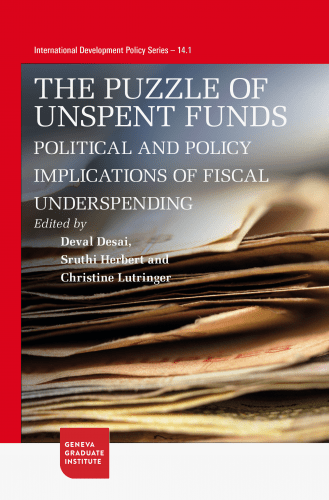
Publication: “The Puzzle of Unspent Funds”

This special issue edited by our project members Deval Desai, Sruthi Herbert and Christine Lutringer explores a matter of critical policy relevance and political importance: the unuse or underuse of public funds, and more specifically of special purpose social funds. The contributions ask: why are there unspent social purpose funds, what do they tell us about the structures of the administrative state, and what can be done to remedy the situation?

The eight chapters, which include contributions by project members Tanushree Kaushal, Luciano Monti and Anna Rita Ceddia, span across two different contexts : India and Italy. These radically different contexts also present valuable points of comparison. The analyzed funds diverge in terms of their institutional design, type of benefits and eligibility of beneficiaries. At the same time, they sit within decentralized democratic frameworks and fragmented and multilevel governance. Juxtaposing the cases, the papers reveal key processes related to fiscal, administrative and policy practices that cause underspending. The papers provide an innovative vantage point to analyze institutional design and reforms in multilevel governance contexts; administrative and bureaucratic state practices; modalities of state-society engagement; and mechanisms to increase democratic accountability.

Desai, D., S. Herbert and C. Lutringer (eds) (2022) The Puzzle of Unspent Funds. Political and Policy Implications of Fiscal Underspending, International Development Policy / Revue internationale de politique de dรฉveloppement, 14.1 (Geneva: Graduate Institute Publications). DOI: 10.4000/poldev.5048

Content
  • Deval Desai, Sruthi Herbert and Christine Lutringer: Introduction. Critical Issues Emerging from the Study of Unspent Funds
  • G. K. Karanth: Managing Unspent Funds when Money is Scarce: Karnataka State Construction and Other Workers Welfare Board (kcowwb)
  • Lipin Ram: Funds Spent: The Lessons and Challenges of Keralaโ€™s Exceptional Experience
  • Tanushree Kaushal: The Aestheticisation of Governance in India: The Appeal of Urban Aesthetics in Microfinance
  • Himanshu Upadhyaya: Registration, Expenditure and Audit Trends: A Technical Commentary on the Karnataka Building and Other Construction Workersโ€™ Welfare Board
  • Christine Lutringer: The Puzzle of โ€˜Unspentโ€™ Funds in Italyโ€™s European Social Fund
  • Luciano Monti: The Italian Puzzle of the European Youth Guarantee
  • Anna Rita Ceddia: The Pivotal Role of Mid-level Implementation Bodies in Italyโ€™s Cohesion Policy  

“Concepts without borders”: Reversing the Gaze at the VAD Conference

Watch the roundtable and panels convened by our project members at the conference of the Association for African Studies in Germany (VAD) in Freiburg im Breisgau (7-10 June 2022).

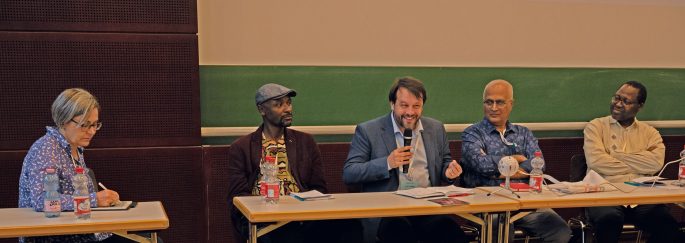
Rose Marie Beck, Patricio Langa, Ralph Weber, Peter Ronald DeSouza and Elรญsio Macamo at the roundtable “Concepts Without Borders”, VAD Conference in Freiburg i.Br., 8 June 2022

Concepts without borderS – reciprocating analytical perspectives

Roundtable chaired by Elisio Macamo (University of Basel) and Ralph Weber (University of Basel)

Speakers: Patrรญcio Langa (UWCUEM), Peter DeSouza (Retired Professor), Rose Marie Beck (University of Leipzig), Claudia Derichs (HU Berlin)


The politics and epistemic value of positionality

Panel convened by Lerato Posholi and Ralph Weber


Translating concepts from Africa to Europe

Panel convened by Winnie Kanyimba and Matthias Maurer Rueda


Workshop: “The Philosophy and Global Politics of Concept Travel”

Veli Mitova (African Centre for Epistemology and Philosophy of Science, University of Johannesburg) during her presentation titled “Wilful Ignorance and Concept Travel”.

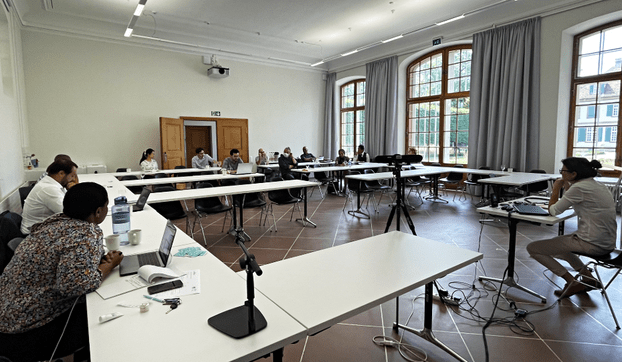
On June 17, the workshop on “The Philosophy and Global Politics of Concept Travel” brought together philosophers and social scientists from India, South Africa and Switzerland to reflect on the link between concept travel, conceptual engineering and the politics of knowledge production. The discussions raised various issues about the dominance of Eurocentric concepts in social science; possible advantages and disadvantages of concept travel; and outlined some strategies for conceptually engineering concepts.

The workshop was part of Lerato Posholi and Ralph Weber’s work package in the “Reversing the gaze” project and was organized in collaboration with Prof. Veli Mitova from the African Centre for Epistemology and Philosophy of Science, University of Johannesburg.

Research Colloquium, Spring Semester 2022: “Working with the state”

In this semester, the colloquium will focus on the ways in which academic and non-academic interpretations of the concept of โ€˜the stateโ€™ vary in different contexts. Drawing from case studies of the research project โ€œReversing the Gazeโ€ as well as guest talks, the sessions will shed light on research endeavors involving the travel and translation of concepts across different regions, disciplines and research foci.


program

Mon 14.03.2022, 12:30-14:00
Is the state an ideological power?
Tebuho Winnie Kanyimba & Matthias Maurer Rueda (Centre for African Studies Basel/Department of Social Sciences, University of Basel)


Mon 28.03.2022, 12:30-14:00
The Postcolonial African State in Transition
Lerato Posholi (Institute of European Global Studies, University of Basel)


Mon 11.04.2022, 12:30-14:00
Retribalization and the State in Switzerland
Tebuho Winnie Kanyimba & Matthias Maurer Rueda (Centre for African Studies Basel/Department of Social Sciences, University of Basel)


Mon 25.04.2022, 12:30-14:00
A Colonial History of Pensions: The East India Company and One Genesis for the Welfare State
Geeta Patel (Middle Eastern & South Asian Languages & Cultures/Women, Gender & Sexuality, University of Virginia)


Mon 09.05.2022, 12:30-14:00
The State, Infrastructure, and Populism
Stephan Hochleithner (Department of Geography, University of Zurich)


Mon 23.05.2022, 12:30-14:00
Review session
Stephan Hochleithner (Department of Geography, University of Zurich)


The colloquium takes place online via Zoom. If you are interested in participating, please register via email to: rtg@unibas.ch.


PhD candidates and advanced MA students can earn credits (3 ECTS credit points). In order to do so, participants should write a report on one of the sessions.

PhD candidates and students at the University of Basel can register for the course via MOnA (course no. 64025-01).

PhD candidates and students at other Swiss universities can register via the University of Basel Student Administration Office.

Book Chapter: ”Comparative philosophy and comparison” by Ralph Weber

Comparative philosophy is lively and the field is diverse and assembles different, sometimes even contradictory views. In his contribution to the edited volume ”Comparative Methods in Law, Humanities and Social Sciences”, Ralph Weber presents these different views and then proceeds to deal with the current conceptualisation of the logic of comparison, with specific attention for diminishing bias and the adequacy of bases of comparison. He helpfully states that one way of investigating the inner dynamics of a given comparison is to ask a set of questions: Who is performing the comparison? What commonality supports the choice of what has to be compared? What is being compared with what? In what respect(s) does the comparer compare that which they compare? What relation results from comparing what the comparer compares in that particular respect? How does the choice of the pre-comparative tertium restrict the realm of possible tertia comparationis? How does a chosen tertium comparationis qualify the comparanda? And what role does the comparanda play in the result of the comparison? Each of these questions reveals an enormous complexity, and the answers may be subject to criticism or require further clarification and substantiation. Moreover, most if not all of these questions are highly relevant for comparative legal research too. Weber also deals with some specific issues, such as generalisation, one-sidedness, and the identification of similarities and differences.

Call for Papers: “Post-Pandemic Mobilisation and Management of Social Welfare Funds”

Project members Sruthi Herbert and Deval Desai host a workshop on “Post-Pandemic Mobilisation and Management of Social Welfare Funds: Implications for Equity and Citizenship” at the annual conference of the Development Studies Association (6-8 July 2022). They discuss the fiscal and administrative practices that emerged in public welfare spending after the COVID-19 pandemic through the lens of equity and citizenship.

The workshop explores a matter of critical policy relevance and political importance: the fiscal and administrative practices that emerged post-pandemic to rapidly mobilise funds for the pandemic relief, and its implications for equity and citizenship. The case-study of special-purpose vehicles (SPVs) in India guides this discussion.

Sruthi Herbert and Deval Desai (Edinburgh) will be the co-convenors. They welcome abstracts for papers from scholars, writers and activists engaged in monitoring and analysing the management and use of public/earmarked funds in India or other regions of the world.

The deadline for submissions is 4 March 2022. The conference is taking place online on 6-8 July, organised and hosted by University College London.

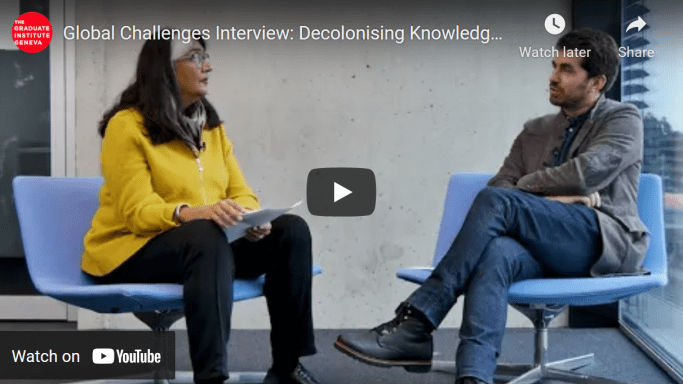
“Decolonising Knowledge”: Interview with Shalini Randeria

The October 2021 edition of Global Challenges from the Graduate Institute of Geneva (IHEID) features Reversing the Gaze fellow, Shalini Randeria, in conversation with IHEID Director of Research and Professor of Anthropology and Sociology, Grรฉgoire Mallard. The video interview “Decolonising Knowledge: A Historical Perspective from Socio-Anthropology” appears in the introduction of the recently published research webzine.

Global Challenges is a series of dossiers aimed to communicate the ideas, expertise, perspectives, and discussions generated by the Graduate Institute of International and Development Studies with a larger, non-specialist audience.


Shalini Randeria

Research Colloquium, Fall Semester 2021: “Making concepts work”

The focus of this semester is on the translation and operationalization of social scientific concepts in specific historical contexts and socio-cultural environments. The colloquium will engage with methodological and theoretical issues bearing on the translation of concepts across regions, across disciplines, and across academic and non-academic contexts.


program

Wed 29.09.2021, 12.15-14.00
Retribalization across time and space
Tebuho Winnie Kanyimba & Matthias Maurer Rueda (Centre for African Studies Basel/Department of Social Sciences, University of Basel)


Wed 13.10.2021, 12.15-14.00
Translating Black-Boxes
Elรญsio Macamo (Centre for African Studies Basel/Department of Social Sciences, University of Basel)


Wed 27.10.2021, 12.15-14.00
Unspent Funds: Mobilisation and Accountability Post-COVID
Sruthi Herbert (University of Edinburgh), Christine Lutringer (Graduate Institute Geneva)


Wed 10.11.2021, 12.15-14.00
Chatterjee Revisited: Contextualizing Political Societies
Stephan Hochleithner & Benedikt Korf (Department of Geography, University of Zurich)


New date: Wed 01.12.2021, 12.15-14.00
Translating Forms of Knowledge
Maria Paula Meneses (Centro de Estudos Sociais e Econรณmicos, Universidade de Coimbra)


Wed 08.12.2021, 12.15-14.00
Review session
Ralph Weber (Institute of European Global Studies, University of Basel)


The colloquium takes place online via Zoom. If you are interested in participating, please register via email to: rtg@unibas.ch.


PhD candidates and advanced MA students can earn credits (3 ECTS credit points). In order to do so, participants should write a report on one of the sessions.

PhD candidates and students at the University of Basel can register for the course via MOnA (course no. 62347-01).

PhD candidates and students at other Swiss universities can register via the University of Basel Student Administration Office.