
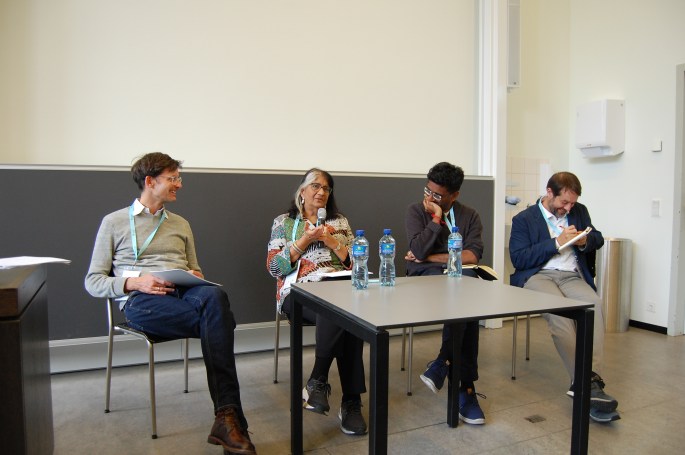
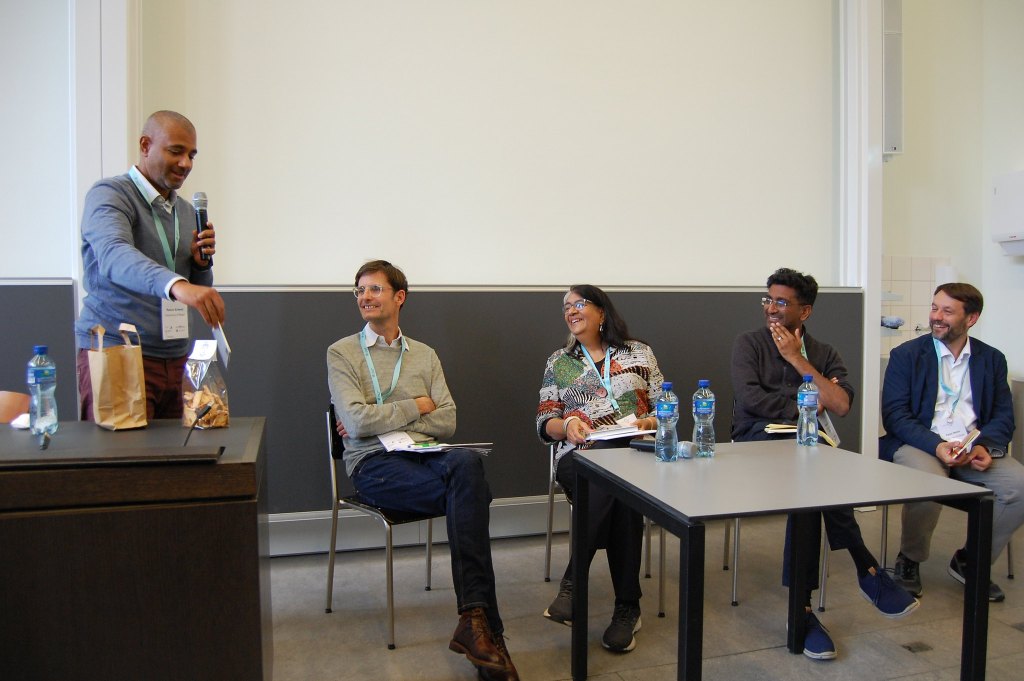
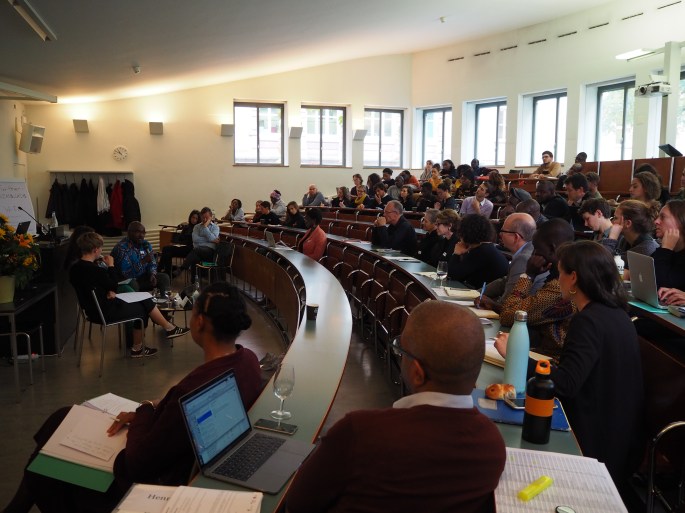
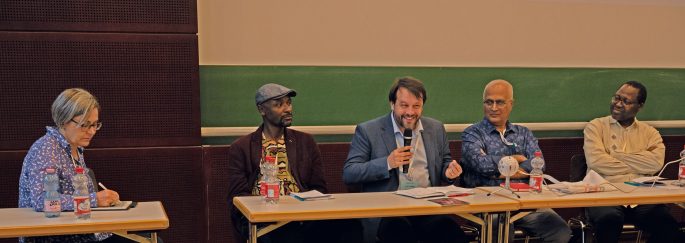
On 12 and 13 September, 45 international scholars met at the University of Basel to explore approaches of ‘reversing the gaze’ and reflect on the use of concepts across borders in the social sciences. In six panel session, participants shared and discussed approaches to using social scientific concept across historical and regional contexts. In the keynote session, Shalini Randeria (Central European University) addressed perspectives and challenges of postcolonial knowledge production in the past, present and future. Finally, the concluding roundtable session with Rose Marie Beck (Karlsruhe University of Applied Sciences), Patricio Langa (Eduardo Mondlane University/University of Essen) and Peter DeSouza (formerly Centre for the Study of Developing Societies CSDS, New Delhi) provided an opportunity to discuss epistemological, methodological and political implications of ‘reversing the gaze’ and to explore new perspectives for knowledge production with a global or trans-regional outlook.
Background
The use of concepts deemed ‘Eurocentric’ in analyzing the global South is heavily criticized within the context of postcolonial and decolonial debates. Such critiques are concerned with the entanglement of the concepts and their colonial context – whether a moral concern with the possibility that colonial worldviews are ineradicably present in the forms and substance of these concepts; an empirical concern with the complicity of these concepts in colonial projects of rule, violence, and extraction; or a concern that colonial structures (e.g. racial hierarchies; geographies of center and periphery) are replicated in conceptual structures in ways that limit their validity or utility. Furthermore, critics lament the traditional geography of theory, whereby the West gazes towards the Rest, and in doing so imagines the universality of the former and particularity of the latter.
In doing so, these critiques raise doubts about the assumption that concepts can be analytically fruitful beyond their context of origin and the normative assumptions on which they are based. The project “Reversing the Gaze: Towards Post-Comparative Area Studies” takes as its core issue whether concepts are inextricably tied to their context and the circumstances of their origins. It does so by deploying concepts used to describe identifiable social and institutional phenomena, typically used to account for phenomena in non-European settings, to study similar empirical phenomena in Europe. The conference “Reversing the Gaze. Concepts without borders” brought together project members and interested scholars to explore theoretical and empirical questions related to applying socio-scientific concepts across regional and historical contexts.
Gallery








 Reversing the Gaze: Towards Post-Comparative Area Studies