Publication: โ€œAfrican Studies, or How to Make the Canon Apocryphalโ€

In his essay in the edited volume ” Knowing – Unknowing. African Studies at the Crossroads”, project PI Elรญsio Macamo rewrites parts of Kantโ€™s โ€œWhat is Enlightment?โ€ as a starting point to explore African studiesโ€™ contribution to a critical reflection on methodology in the social sciences.

Macamo, Elรญsio. โ€œAfrican Studies, or How to Make the Canon Apocryphal.โ€ In Knowing – Unknowing. African Studies at the Crossroads, edited by Sabelo J. Ndlovu-Gatsheni and Katharina Schramm, 4:31โ€“45. Africa Multiple. Leiden, Boston: Brill, 2024.

International conference at the University of Basel (12-13 Sept 2024): “Reversing the Gaze: Concepts without borders”

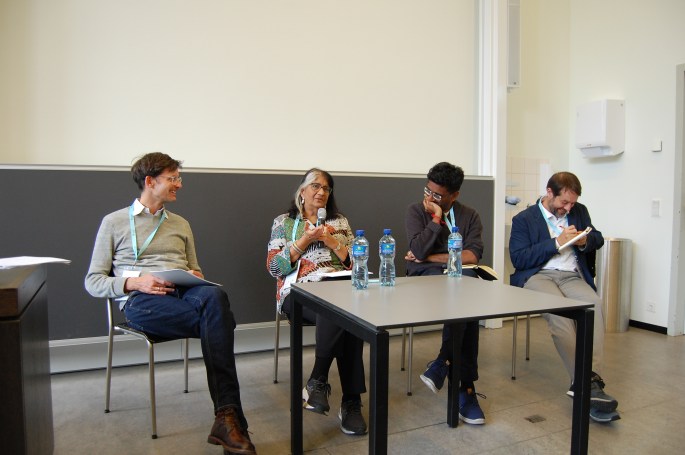
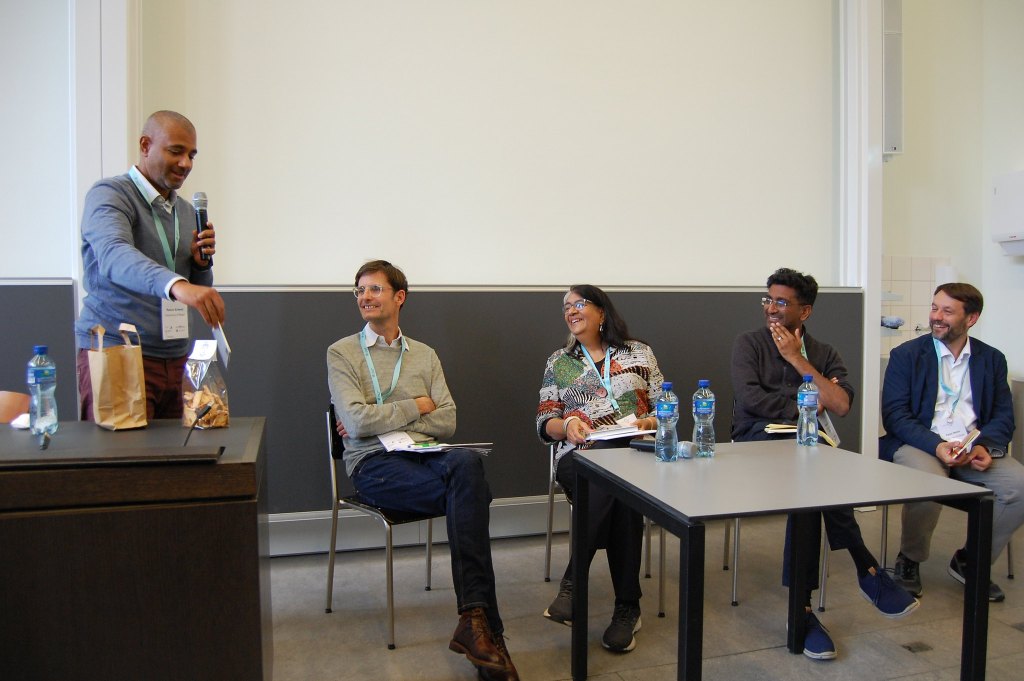
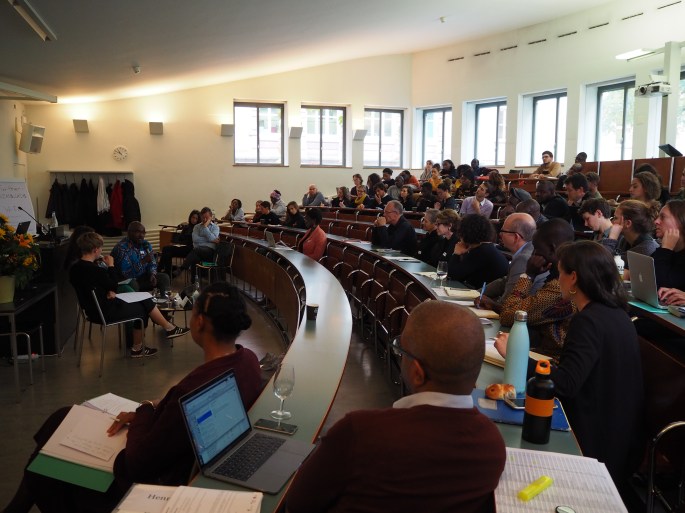
On 12 and 13 September, 45 international scholars met at the University of Basel to explore approaches of โ€˜reversing the gazeโ€™ and reflect on the use of concepts across borders in the social sciences. In six panel session, participants shared and discussed approaches to using social scientific concept across historical and regional contexts. In the keynote session, Shalini Randeria (Central European University) addressed perspectives and challenges of postcolonial knowledge production in the past, present and future. Finally, the concluding roundtable session with Rose Marie Beck (Karlsruhe University of Applied Sciences), Patricio Langa (Eduardo Mondlane University/University of Essen) and Peter DeSouza (formerly Centre for the Study of Developing Societies CSDS, New Delhi) provided an opportunity to discuss epistemological, methodological and political implications of โ€˜reversing the gazeโ€™ and to explore new perspectives for knowledge production with a global or trans-regional outlook.

Background

The use of concepts deemed โ€˜Eurocentricโ€™ in analyzing the global South is heavily criticized within the context of postcolonial and decolonial debates. Such critiques are concerned with the entanglement of the concepts and their colonial context โ€“ whether a moral concern with the possibility that colonial worldviews are ineradicably present in the forms and substance of these concepts; an empirical concern with the complicity of these concepts in colonial projects of rule, violence, and extraction; or a concern that colonial structures (e.g. racial hierarchies; geographies of center and periphery) are replicated in conceptual structures in ways that limit their validity or utility. Furthermore, critics lament the traditional geography of theory, whereby the West gazes towards the Rest, and in doing so imagines the universality of the former and particularity of the latter.

In doing so, these critiques raise doubts about the assumption that concepts can be analytically fruitful beyond their context of origin and the normative assumptions on which they are based. The project โ€œReversing the Gaze: Towards Post-Comparative Area Studiesโ€ takes as its core issue whether concepts are inextricably tied to their context and the circumstances of their origins. It does so by deploying concepts used to describe identifiable social and institutional phenomena, typically used to account for phenomena in non-European settings, to study similar empirical phenomena in Europe. The conference โ€œReversing the Gaze. Concepts without bordersโ€ brought together project members and interested scholars to explore theoretical and empirical questions related to applying socio-scientific concepts across regional and historical contexts.

Gallery

Conference "Reversing the Gaze: Using Concepts Across Borders" (University of Basel, 12-13 September 2024)

Publication: “Recasting Welfare Politics in India at the Time of COVID-19”

Project member Christine Lutringer‘s recent book chapter explores state-society relations and subnational responses to the COVID-19 crisis in India. By examining the intersection of governance and welfare, Lutringer reveals the shifts and tensions in state-society relations that have been induced by the pandemic. The chapter argues that not only the policy response of the central government in Delhi but also the narratives and discourses of the pandemic intrinsically relate to the ways in which “welfare” has been constructed in India.

“Recasting Welfare Politics in India at the Time of COVID-19” by Christine Lutringer (2023) is published in Milanetti, Giorgio, Miranda, Marina and Morbiducci, Marina (eds.) The COVID-19 Pandemic in Asia and Africa. Societal Implications, Narratives on Media, Political Issues. Volume II โ€“ Society and Institutions. The book is published by Sapienza Universitร  Editrice and is available as Open Access.

Conference at the University of Basel

Call for papers: “Reversing the Gaze: Using Concepts Across Borders”

The use of concepts deemed โ€˜Eurocentricโ€™ in analyzing the global South is heavily criticized within the context of postcolonial and decolonial debates. Such critiques are concerned with the entanglement of the concepts and their colonial context โ€“ whether a moral concern with the possibility that colonial worldviews are ineradicably present in the forms and substance of these concepts; an empirical concern with the complicity of these concepts in colonial projects of rule, violence, and extraction; or a concern that colonial structures (e.g. racial hierarchies; geographies of center and periphery) are replicated in conceptual structures in ways that limit their validity or utility. Furthermore, critics lament the traditional geography of theory, whereby the West gazes towards the Rest, and in doing so imagines the universality of the former and particularity of the latter.

In doing so, these critiques raise doubts about the assumption that concepts can be analytically fruitful beyond their context of origin and the normative assumptions on which they are based. The project โ€œReversing the Gaze: Towards Post-Comparative Area Studiesโ€ takes as its core issue whether concepts are inextricably tied to their context and the circumstances of their origins. It does so by deploying concepts used to describe identifiable social and institutional phenomena, typically used to account for phenomena in non-European settings, to study similar empirical phenomena in Europe. Case studies apply the concepts โ€œre-tribalizationโ€, โ€œpolitical societyโ€ and โ€œthe cunning stateโ€ to study, respectively, citizenship in Switzerland, populism in Austria and social welfare spending in Italy.

This conference brings together reflections on the use of concepts across borders in social sciences. The conference has two aims. The first aim is to share and discuss the results of our three case studies, and to examine other cases of applying socio-scientific concepts across regional or historical contexts. The second aim is to explore the epistemological and methodological implications of turning the gaze traditionally directed at the Rest towards the West. The discussions of the case studies will present key substantive findings from the studies, providing some concrete material for reflecting on epistemological and philosophical questions about concepts, and hopefully these questions will inform interpretations of the results of the case studies.

Furthermore, we wish to bring this work into conversation with other research that explores theoretical and/or empirical questions related to:

  1. The functions and performativity of social-scientific concepts of specific social and institutional phenomena, i.e. whether they produce descriptions, or whether the deployment of concepts itself produces the objects which concepts describe.
  2. Conceptual change in such concepts, i.e. whether (and how) concept use, scope and meaning change fundamentally according to where, why and by whom they are deployed.
  3. Theoretical and political aspects of the use of such concepts across borders, i.e. whether the use of some concepts can be inappropriate for the study of particular contexts due to some properties of the concepts and/or studied contexts.

To this end, we welcome contributions addressing these questions and related others from any discipline and research field.


Submitting a proposal

Paper proposals should include a title and a description (in English, maximum 2000 characters) as well as name, e-mail address and institutional affiliation/function of the author(s).

Proposals must be submitted via the Evasys submission form.


Timeline & practical information
  • Call for papers: 15.12.2023
  • Deadline for paper submissions: 15.03.2024
  • Notice of acceptance: 15.04.2024
  • Conference: 12-13.09.2024

Detailed program, venue and fees to be announced


Best Paper Prize (runner up) for Deval Desai

The Society of Legal Scholars (SLS) awarded RtG project member Deval Desai the Best Paper Prize (runner up) for his paper โ€˜Theorising the anti-fiscal state: evidence from Indiaโ€™ at their Annual Conference 2023. The SLS is the principal representative body for legal academics in the UK whose aim is the advancement of legal education and scholarship in the UK and Ireland.

Desaiโ€™s paper ties in with the project research on government underspending undertaken by his work package.

Read more on the website of the Edinburgh Law School.

Other recent publications by Desai include โ€˜Law and the political stakes of global crises: Lessons from development practice for a coronavirus worldโ€™, published by Law and Policy and available as Open Access. This article explores the relationship between law and crisis, in particularly the lessons the Global North can learn from experiences in the Global South, where such thinking is framed in terms of โ€˜developmentโ€™.

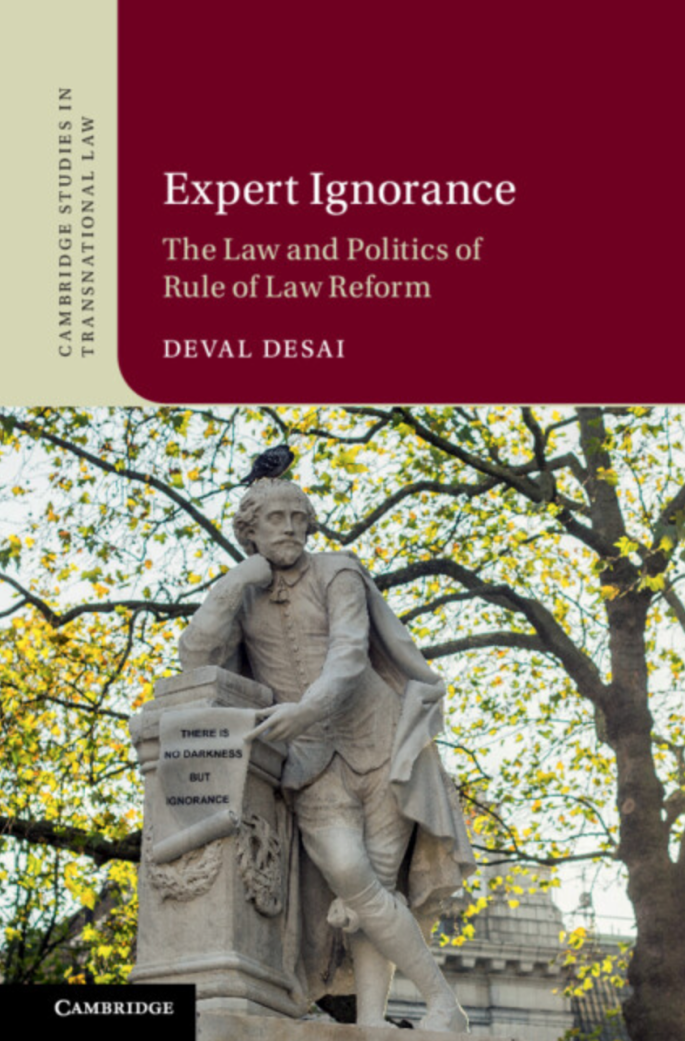
Publication: “Expert Ignorance”

This recent book by project member Deval Desai explores the concept of โ€˜expert ignoranceโ€™, whereby ideas about the โ€˜rule of lawโ€™ remain undefined and are indeed kept underdetermined by structures of expertise. This, in turn, regulates their ability to travel beyond their context, for example, in their application in the Global South. Desaiโ€™s interdisciplinary approach spans legal theory, development practice, global economic governance and sociology to demonstrate โ€œthe enduring power of proclaiming what one does not know.โ€

Expert Ignorance is published by Cambridge University Press as part of the Cambridge Studies in Transnational Law series, and is available as Open Access on Cambridge Core.

Workshop: โ€˜Decolonising Political Theologiesโ€™ in Conversation with James Sidaway (Zurich, 26 May 2023)

Convened by Benedikt Korf, Department of Geography, University of Zurich, with James Sidaway, Department of Geography, National University of Singapore


Date: 26 May 2023, 09:00am โ€“ 12:00pm
Venue: Collegium Helveticum, Rudolf Wolfs Saal, Schmelzbergstrasse 25, 8092 Zรผrich

Contact:
Benedikt Korf: benedikt.korf@geo.uzh.ch 


This half-day seminar will discuss James Sidaway’s forthcoming paper ‘Beyond the decolonial: Critical Muslim geographies’ and bring it in conversation with political theologies from elsewhere โ€“ beyond ‘Muslim geographies’ and beyond ‘Europe’ in a post- and/or de-colonial spirit.

James Sidaway is Professor of Political Geography at the National University of Singapore (NUS). His input will be followed by contributions from three discussants, and a lightning session.

Please register your interest with Benedikt Korf at: benedikt.korf@geo.uzh.ch 


Research Colloquium, Spring Semester 2023: “Beyond Area Studies”

In this semester, the colloquium will focus on current debates in and critics of Area Studies and the various attempts to save them (e.g. new area studies, global area studies). We will discuss theoretical and methodological implications of using socio-scientific concepts across regional or historical contexts for our understanding of Area Studies and, in particular, the role of relationality with regards to both the scope of inquiry (as opposed to the object of inquiry) and the configuration of the region or area of study.


programme

Mon 06.03.2023, 12:30-14:00 CET
Introduction: Beyond Area Studies
Benedikt Korf (Department of Geography, University of Zurich)


Mon 20.03.2023, 12:30-14:00 CET
Area studies, geography and critical Muslim studies
James Derrick Sidaway (Department of Geography, National University of Singapore)


Mon 03.04.2023, 12:30-14:00 CET
The Globality of Higher Education Research as an Area Study
Patrรญcio Langa (University of the Western Cape/Eduardo Mondlane University)


Mon 24.04.2023, 12:30-14:00 CET
Area studies and other containers
Aline Schlรคpfer (Department of Social Sciences, University of Basel)


Mon 22.05.2023, 12:30-14:00 CET
Review session


The colloquium takes place online via Zoom. If you are interested in participating, please use the registration form to register for one or several sessions.


PhD candidates and advanced MA students can earn credits (1 ECTS credit point).

PhD candidates and students at the University of Basel can register for the course via MOnA (course no. 67655-01).

PhD candidates and students at other Swiss universities can register via the University of Basel Student Administration Office.

Workshop: “The Cultural Life of Democracy” (Zurich, 3-4 Nov 2022)

Convened by Harshana Rambukwella and Benedikt Korf, Department of Geography, University of Zurich


Date: 3 & 4 November 2022
Venue: Vรถlkerkundemuseum, Universitรคt Zรผrich

Contact:
Harshana Rambukwella: h.rambukwella@gmail.com 
Benedikt Korf: benedikt.korf@geo.uzh.ch 


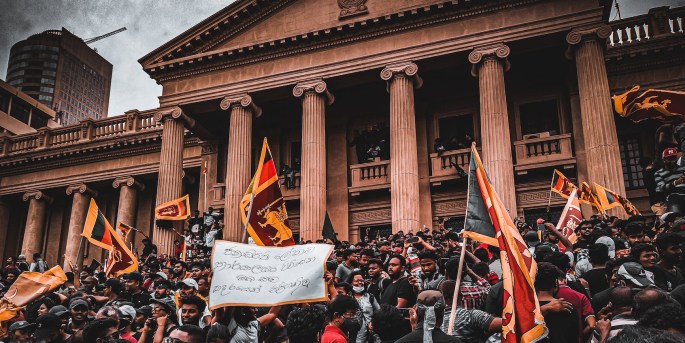
This workshop is a modest attempt to broaden the critical discourse on democracy by using Sri Lanka as an empirical locus, but adopting a comparative gaze beyond Sri Lanka, and to explore the possibilities of fashioning the โ€˜cultural life of democracyโ€™ as a conceptual and methodological heuristic to explore democracy and democratization as an actual political practice rather than a political ideal. Politically and intellectually the project aligns with the โ€˜post-colonialโ€™ spirit of exploring โ€˜alternativeโ€™ accounts of democracy but is also cautious of how populist-authoritarian iterations of democracy have rationalized themselves through claims to alterity. Challenging the dominance of what Chakrabarty (2000) calls โ€˜hyperreal Europeโ€™ there have been attempts to understand democracy in relation to postcolonial social experience. These include, drawing on the practice of adda in Calcutta society as a form of public sphere (Chakrabarty 2000), rethinking democracy from the margins in Chile where the isolated Chachapoyas region has historically resisted integration by self-consciously constructing itself as a pre-modern and pre-political society (Nugent 2002) and examining Islamic forms of democratic participation in Arabian societies that do not follow the Turkish โ€˜secularistโ€™ model (Rane 2010). Collectively, these can be understood as forms of democratic participation that do not follow a rigid definition of democratic norms. This approach to โ€˜provincializingโ€™ democracy has also yielded a number of studies that attempt to map civic life in South Asian societies (Orsini 2000; Dass 2015; Scott et al. 2016). The workshop thereby aligns with the agenda of the SINERGIA project โ€œReversing the Gazeโ€, which seeks to unsettle the Eurocentrism of democratic theory.

Taking Sri Lankaโ€™s current political crisis as well as its varied history of democracy as a case, this workshop invites critical and comparative reflection on postcolonial theories of democracy, electoral politics and political dissent beyond the Sri Lankan case. The term โ€œcultural lifeโ€ starts from the supposition that the cultural is often a site of political struggle, but also, that politics develops a cultural life of itself: in the events it celebrates, the rituals it performs, the narratives it produces and the mundane practices it follows in the everyday. Studying how exactly these different modes of political conduct are mobilized and negotiated gives us an insight into โ€œactually existing politicsโ€ (Spencer 2007: 177). Studying actually existing politics raises normative questions: We recognize that discourses like โ€˜post-truthโ€™ have led to an erosion of norms such as โ€˜civilityโ€™, a class-driven but vital norm theorized by scholars like Norbert Elias and Pierre Bourdieu (Thiranagama et al. 2018). Similarly, populist leaders have redefined sovereignty in self-serving ways that draw on the rhetoric of decolonization. The theoretical and political challenge, therefore is in fashioning a stance that recognizes that โ€˜civilityโ€™, for instance, has a loaded colonial history (Thiranagama et al. 2018: 163- 64) โ€“ but at the same time does not romanticize populism or restrict democracy to a set of culturally exclusivist markers.

Specifically, the workshop intends to explore the following interdisciplinary questions:

  1. What insights can a โ€˜culturalโ€™ account of democracy offer for postcolonial societies like Sri Lanka, which โ€˜standardโ€™ accounts of democracy and democratization such as the study of democratic institutions, the rule of law, etc., are unable to offer.
  2. How can we trace the โ€˜cultural lifeโ€™ of democracy in varied forms of artistic production such as art, literature, film and theatre, but also political activism and events?
  3. What are the methodological and conceptual challenges of a project of this nature with its interdisciplinary and methodologically eclectic approach?

Workshop: “Decoloniality and the Politics of the Urban” (hybrid, 27 Oct 2022)

The Geneva Graduate Institute, the Reversing the Gaze Project and the Institute for Advanced Studies in the Humanities (IASH) invite you to participate in an upcoming workshop, exploring themes of decoloniality in relation to the politics of the urban.

Date: 27th October 2022
Time: 9:00-16:30 UK time
Format: Hybrid

What is the politics of the divide between the urban and the non-urban (semi-urban, peri-urban and the rural), in contemporary postcolonial and metropolitan contexts, as well as historical colonial contexts? The divide is fundamental to the emergence of modern states as political-economic entities – European, colonial, and developmental. It expresses a politics of concentration/scale, productivity, specialisation, and movement to be governed. Crucially, colonial histories and categories of urban and rural and their relationship to productive and unproductive labour give shape to internal hierarchies of citizenship within states. The politics of these categories manifest themselves in historic rubrics of retribalisation, and contemporary politics of internal labour migration and populist resentment. The divide is of interest as at once a material site, political framework, and historical stage for the making of colonial and postcolonial states โ€“ and potentially for the continuation of an โ€œunfinished project of decolonisationโ€.

This is a unique opportunity to engage with interdisciplinary scholarship on relevant themes of decoloniality, both historical and contemporary. If youโ€™re interested in participating in a panel, kindly submit a short abstract (no more than 200 words) to tanushree.kaushal@graduateinstitute.ch and deval.desai@ed.ac.uk with the title โ€˜Decoloniality Workshop Submissionโ€™ and your name and affiliation by October 3th, 2022. If you have any questions, feel free to contact Tanushree at tanushree.kaushal@graduateinstitute.ch.